beyerdynamic
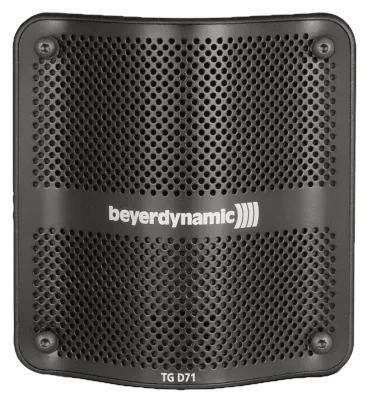
beyerdynamic TG D71
Back-electret condenser boundary mic, half-cardioid, for inside a kick drum (also cajon, piano)
Power Phantom P12 to P48 (11 to 52 V).
- Type
- Condenser (electret)
- Pattern
- Half-cardioid
- Sensitivity
- −56 dBV/Pa
- Among 311 mics: more output than 10%
- Self-noise
- 31.2 dB(A)
- Among 272 mics: quieter than 2%
- Max SPL
- 148 dB SPL
- Among 343 mics: takes louder sound than 87%
- Rated range
- 25 – 20k Hz
vs 204 condensers
More output than 2% of 204 condensers.
Each stripe is one condenser with a published sensitivity, and each bar counts them; further right means more output. This mic is in blue.
vs 258 condensers
Quieter than 2% of 258 condensers.
Each stripe is one condenser with a published self-noise, and each bar counts them; further right means quieter. This mic is in blue.
vs 277 condensers
Takes louder sound than 88% of 277 condensers.
Each stripe is one condenser with a published max SPL, and each bar counts them; further right means it takes louder sound. This mic is in blue.
Instruments sources recommend it for most
Proximity effect: the bass it gains up close
From the spec sheet, p. 2.
Titled "Frequency response curve ± 3 dB", "0 dB = 1.5 mV/Pa"; "measuring tolerance ± 3 dB", "correspond to a typical production sample". Mounting (on a boundary or not), room and smoothing not stated.
Dashed: outside the rated range, or simulated (other angles and distances). Hover or tap the graphs for values.
Polar pattern
From the spec sheet, p. 2.
Untitled polar under "Frequency response & polar pattern" ("a typical production sample"); one full circle, 0° at the top, 5 dB rings to -20 dB. Measuring conditions and mounting not stated.
In practice
All specs
| From the spec sheet | ||
|---|---|---|
| Sensitivity | −56 dBV/Pa (1.5 mV/Pa)open circuit voltage. "Open circuit voltage 1.5 mV/Pa (-56 dBV)". | p. 1 |
| Self-noise | 31.2 dB(A)"A-weighted equivalent SPL 31.2 dB"; noise voltage 1.1 µV [A, RMS]. | |
| Self-noiseCCIR 468 | 44 dBNot stated by the manufacturer: 94 dB minus the stated CCIR signal-to-noise ratio, "50 dB [CCIR, Q-Peak]"; noise voltage 4.9 µV [CCIR, Q-Peak]. | |
| Max SPL | 148 dB SPL1 kHz, 1% THD. "Max. SPL at 1 kHz 148 dB [SPL@1% THD]". | |
| Signal-to-noise ratio | 63 dBA-weighted, RMS; also 50 dB, CCIR, Q-peak | |
| Output impedance | 200 ohmnominal, "< 200 Ω". "Nominal impedance < 200 Ω"; stored as 200. | |
| Rated load impedance | 1000 ohmminimum ("≥ 1 kΩ") | |
| Rated frequency range | 25 Hz to 20 kHz"Frequency response 25 - 20,000 Hz". | |
| Powering | phantom P12 to P48 (11 to 52 V)P48, P24 and P12 listed; the text says "11 to 52 V phantom power". | |
| Current draw | 3.2 mAmaximum ("< 3.2 mA") at P48, P24 or P12 | |
| Connector | XLR-3 male"XLR, 3-pin, male"; balanced. | |
| Weight | 413 g | |
| Dimensions | 90 × 86 × 27 mm"Dimensions without connector (L x W x H) 90 x 86 x 27 mm". | |
| Order number | 708.992 | |
| Noise voltage | 1.1 µV [A, RMS], 4.9 µV [CCIR, Q-Peak] | |
| Polarity | Positive pressure produces positive voltage on pin 2 in relation to pin 3 | |
| Phantom power detail | P48 (+48 V ±4 V, 6.8 kΩ ±20%), P24 (+24 V ±4 V, 1.2 kΩ ±20%), P12 (+12 V ±4 V, 680 Ω ±20%), each < 3.2 mA | |
| Status LED | Red LED lights when phantom power is applied | |
| Mounting | Non-slip rubber bottom, laid in the drum without a mount; two mounting holes underneath for permanent installation | |
| Optional accessories | BMC 05 FM cable, XLR-XLR 5 m (434.787); BMC 10 FM cable, XLR-XLR 10 m (434.795) | |
| Graph tolerance | "measuring tolerance ± 3 dB"; "correspond to a typical production sample" | p. 2 |
| From the manual | ||
| Placementbeyerdynamic | Lay it in the bass drum or cajon; on a grand piano, inside the body, e.g. on the cast frame. Tilting it changes the sound (half-cardioid) | p. 1 |
Documents
- TG D71 Condenser Boundary Microphone, data sheetE2/TG D71 (04.18), order # 708.992
- TG D71 Boundary Microphone, product informationDE, EN, FR; 655.678 (03.19)
- TG D71 - beyerdynamicproduct page
Copies kept by Mic Archive (manufacturers move and drop their documents). Each is © beyerdynamic, unchanged, with its original address.
Recommended for
By recording guides, engineers and mic makers, for this mic or an earlier version of it.
Other mics
More from beyerdynamic
- beyerdynamic M 160
- beyerdynamic M 88 TG
- beyerdynamic M 130
- beyerdynamic M 201
- beyerdynamic M 260
- beyerdynamic MC 740
- beyerdynamic MC 834
- beyerdynamic MC 930