Countryman Associates
Countryman E6
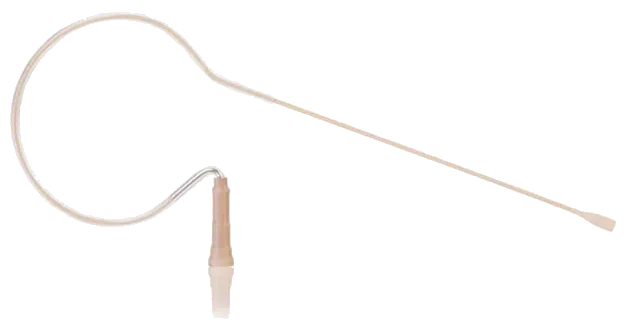
Electret condenser earset mic on a thin boom; this record is the omnidirectional E6 with the standard W5 sensitivity (directional and lower-gain W6/W7 versions also exist)
Power 1-2 V at 500 µA, from a wireless transmitter or phantom power through an XLR cable.
- Type
- Condenser (electret)
- Pattern
- Omni
- Sensitivity
- −43.1 dBV/Pa
- Among 311 mics: more output than 46%
- Self-noise
- 24 dB(A)
- Among 272 mics: quieter than 10%
- Max SPL
- 120 dB SPL
- Among 343 mics: takes louder sound than 3%
- Rated range
- 20 – 20k Hz
vs 204 condensers
More output than 23% of 204 condensers.
Each stripe is one condenser with a published sensitivity, and each bar counts them; further right means more output. This mic is in blue.
vs 258 condensers
Quieter than 11% of 258 condensers.
Each stripe is one condenser with a published self-noise, and each bar counts them; further right means quieter. This mic is in blue.
vs 277 condensers
Takes louder sound than 3% of 277 condensers.
Each stripe is one condenser with a published max SPL, and each bar counts them; further right means it takes louder sound. This mic is in blue.
Instruments sources recommend it for most
Proximity effect: the bass it gains up close
From the spec sheet, p. 1.
"Frequency Response", "Omni" graph, "6 in" (booklet: "measured at 6 inches"); relative dB, labelled. One line per protective cap. Room and smoothing not stated.
Dashed: outside the rated range, or simulated (other angles and distances). Hover or tap the graphs for values.
Polar pattern
From the spec sheet, p. 1.
"1 kHz Polar Response", "Omnidirectional"; rings labelled 0 to -20 dB. Measuring conditions not stated.
In practice
All specs
| From the spec sheet | ||
|---|---|---|
| Sensitivity | −43.1 dBV/Pa (7 mV/Pa)omni W5; also −54 dBV/Pa, omni W6; also −63.1 dBV/Pa, omni W7. "Omni W5: 7.0 mV/Pa", "Omni W6: 2.0 mV/Pa", "Omni W7: 0.7 mV/Pa"; converted (20 log10). Directional versions in specs_extra. | p. 1 |
| Self-noise | 24 dB(A)W5; also 29 dB(A), W6; also 39 dB(A), W7. "Equivalent Acoustic Noise: W5: 24 dBA, W6: 29 dBA, W7: 39 dBA" (omni and directional alike). | |
| Max SPL | 120 dB SPLomni W5, 1% THD (overload sound level); also 130 dB SPL, omni W6; also 140 dB SPL, omni W7. "Overload Sound Level (1% THD): Omni W5: 120 dBA, Omni W6: 130 dBA, Omni W7: 140 dBA"; the booklet says "dB SPL". | |
| Rated frequency range | 20 Hz to 20 kHzomni. "Omni: 20 Hz to 20 kHz"; no tolerance stated. | |
| Powering | 1-2 V at 500 µA, from a wireless transmitter or phantom power through an XLR cable"Power Requirements: 500 µA at 1 to 2 Volts"; cables "for almost any wireless transmitter or for XLR inputs with phantom power". | |
| Current draw | 0.5 mA"500 µA". | |
| Connector | detachable snap-on cable; terminations for most wireless transmitters or XLR (phantom) | |
| Weight | 2 g".07 oz (2 grams)". | |
| Supplied accessories | cable; carrying case; black and white cable clips; windscreen; three protective caps (+0, +4, +8 dB)"Supplied with cable, carrying case, black and white cable clips, windscreen and protective caps"; the three omni caps from the booklet (page 13). | |
| Sensitivity, directional version | W5 6.0 mV/Pa, W6 1.9 mV/Pa, W7 0.6 mV/Pa | |
| Overload sound level, directional version | W5 125 dBA, W6 135 dBA, W7 145 dBA (1% THD) | |
| Frequency response, directional version | 30 Hz to 15 kHz | |
| Sensitivity options | W5 (no band) general speaking, the most popular; W6 (blue band) very loud speaking, theatre and most vocals; W7 (purple band) the most powerful vocals | p. 2 |
| Protective capsomni | +0 dB flat, +4 dB bright (fitted as shipped), +8 dB very bright: each sets the response around 15 kHz | |
| Versions | E6 (springy boom), E6i (soft boom, larger ear piece), E6X/E6 Flex (springy ear loop, soft boom); colours tan, light beige, cocoa, black; 1 mm or 2 mm cable | |
| Feedback rejection | Omni earsets reduce feedback by about 12 dB on average compared with an omni lavalier (Countryman) | p. 1 |
| From the user guide | ||
| Power supply voltagebooklet | +3 V with 2.7 kohm load; +6 V with 5.6 kohm load; +9 V with 15 kohm load | p. 16 |
| From the product page | ||
| Construction | Stainless steel boom; moisture- and make-up-resistant with the protective caps; aramid-reinforced cable with braided RF shield | p. 1 |
Documents
- E6 Earset Microphone data sheet
- E6 Omnidirectional Earset Microphoneuser booklet
- E6 Earsetproduct page
Copies kept by Mic Archive (manufacturers move and drop their documents). Each is © Countryman Associates, unchanged, with its original address.
Recommended for
By recording guides, engineers and mic makers, for this mic or an earlier version of it.