Sanken Microphone Co.
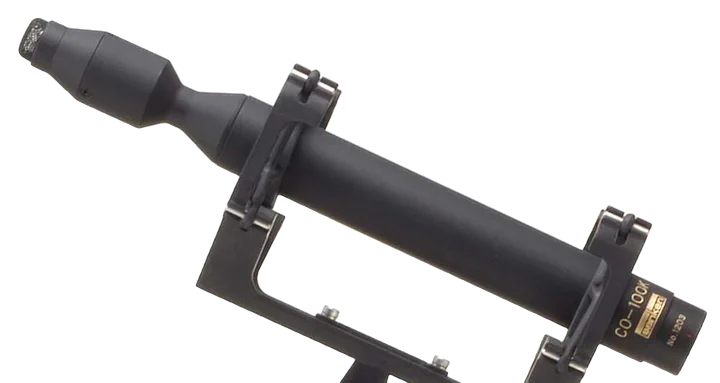
Sanken CO-100K
Omnidirectional condenser mic with a 20 Hz to 100 kHz range, for recording (not measurement)
Approximate Some readings for this mic are uncertain; see the graphs.
Power Phantom, 48 V ± 4 V.
- Type
- Condenser
- Pattern
- Omni
- Sensitivity
- −28 dBV/Pa
- Among 204 condensers: more output than 97%
- Among 311 mics: more output than 98%
- Self-noise
- 22 dB(A)
- Among 258 condensers: quieter than 16%
- Among 272 mics: quieter than 15%
- Max SPL
- 125 dB SPL
- Among 277 condensers: takes louder sound than 10%
- Among 343 mics: takes louder sound than 8%
- Rated range
- 20 – 100k Hz
vs 75 end-address condensers
More output than 99% of 75 end-address condensers.
Each stripe is one end-address condenser with a published sensitivity, and each bar counts them; further right means more output. This mic is in blue.
vs 104 end-address condensers
Quieter than 10% of 104 end-address condensers.
Each stripe is one end-address condenser with a published self-noise, and each bar counts them; further right means quieter. This mic is in blue.
vs 110 end-address condensers
Takes louder sound than 6% of 110 end-address condensers.
Each stripe is one end-address condenser with a published max SPL, and each bar counts them; further right means it takes louder sound. This mic is in blue.
Proximity effect: the bass it gains up close
From the spec sheet, p. 3.
As printed: "(dB)" from -10 to -60; the on-axis level at 1 kHz (about -26.5 dB) is near the stated sensitivity of -28 dB re 1 V/Pa. Distance, field and smoothing not stated.
Dashed: outside the rated range, or simulated (other angles and distances). Hover or tap the graphs for values.
Polar pattern
From the spec sheet, p. 2. Approximate
Rings every 2 dB, labelled 0 to -30 dB; 0° at the top. Drawn as two half-circles: 1, 10 and 20 kHz on the left, 50 and 100 kHz on the right; the pattern is taken as symmetric. Measuring conditions not stated.
Approximate: reading error up to about 1 dB.
In practice
All specs
| From the spec sheet | ||
|---|---|---|
| Capsule | Small diaphragm, own design for response to 100 kHz"Unique Diaphragm Design"; developed with NHK's Science & Technical Research Laboratories. | p. 1 |
| Sensitivity | −28 dBV/Pa (39.8 mV/Pa)nominal at 1 kHz. "39.8mV/Pa ( -28dB,0dB=1V/Pa)". | p. 2 |
| Self-noise | 22 dB(A) | |
| Max SPL | 125 dB SPL1% THD | |
| Output impedance | 150 ohmat 1 kHz | |
| Rated frequency range | 20 Hz to 100 kHz | |
| Powering | phantom, 48 V ± 4 V | |
| Current draw | 6 mAless than | |
| Connector | XLR-3M | |
| Weight | 150 g | |
| Dimensions | 191.5 × 20.5 mmLength × diameter. The drawing shows a 20 mm head and 22.5 mm at the connector end. | |
| Finish | matte black | |
| High-frequency response | Deliberate on-axis peak from 20 to 70 kHz, because sound energy above 20 kHz falls off steeply; directivity rises at high frequencies | p. 3 |
| Use | Classical music, acoustic instruments and sound effects; stereo pairs, string sections, surround arrays | p. 1 |
| Development | Designed with NHK's Science & Technical Research Laboratories | |
| Optional accessories | GS-100 suspension holder; RB-100 spare rubber parts (two per set) | p. 3 |
Documents
- CO-100K: An Omnidirectional Super Wide Range Condenser Microphonespec sheet
Copies kept by Mic Archive (manufacturers move and drop their documents), unchanged, with their original addresses. Each is © its publisher.
Recommended for
By recording guides, engineers and mic makers, for this mic or an earlier version of it.