AEA (Audio Engineering Associates)
AEA R88
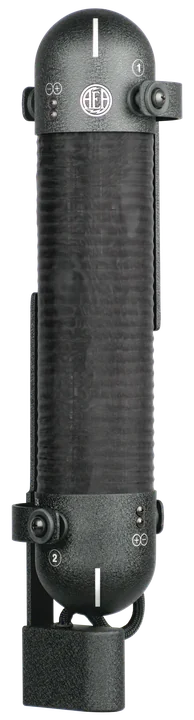
Passive stereo ribbon: two matched figure-8 Big Ribbons in a fixed Blumlein pair (current version R88mk2)
Approximate Some readings for this mic are uncertain; see the graphs.
Power None (passive). Switch phantom power off before you plug it in: a faulty cable can damage the ribbon. Low output: it needs a lot of preamp gain.
- Type
- Ribbon
- Pattern
- Figure-8
- Sensitivity
- −52 dBV/Pa
- Among 28 ribbons: more output than 41%
- Among 311 mics: more output than 26%
- Max SPL
- 165 dB SPL
- Among 29 ribbons: takes louder sound than 86%
- Among 343 mics: takes louder sound than 99%
- Rated range
- 20 – 20k Hz
- Released
- 2004
vs 24 side-address ribbons
More output than 35% of 24 side-address ribbons.
Each stripe is one side-address ribbon with a published sensitivity, and each bar counts them; further right means more output. This mic is in blue.
vs 28 side-address ribbons
Takes louder sound than 85% of 28 side-address ribbons.
Each stripe is one side-address ribbon with a published max SPL, and each bar counts them; further right means it takes louder sound. This mic is in blue.
Instruments sources recommend it for most
Proximity effect: the bass it gains up close
From the manual (Recording Hacks copy), p. 4.
"On-Axis Frequency Response (1 meter)", 200 Hz to 20 kHz. Smoothing not stated; one channel, which is not said. The 2007 one-sheet prints the same graph as "AEA R88 Frequency Response".
Dashed: outside the rated range, or simulated (other angles and distances). Hover or tap the graphs for values.
Polar pattern
From the manual, p. 14. Approximate
"Directivity", "FIGURE-OF-8 POLAR PATTERN", full circle, 0° up, rings every 3 dB to -30 dB. Measuring conditions and which ribbon not stated.
Approximate: reading error up to about 1 dB.
In practice
All specs
| From the manual | ||
|---|---|---|
| Capsule | two corrugated aluminium ribbons, 1.8 µm × 4.7 mm × 59.7 mm, tuned to 16.5 Hz"Thickness: 1.8 µm; Width: 0.185 in (4.7 mm); Length: 2.35 in (59.7 mm)"; tuning on p. 4. The 2004 manual says "very low resonance frequency (16 Hz)". | p. 13 |
| Sensitivity | −52 dBV/Pa (2.5 mV/Pa)into unloaded circuit. "2.5 mV/Pa (-52 dBV) into unloaded circuit" (R88 passive). The 2004/2007 documents: "Output Sensitivity: -52 dBv/Pa". | |
| Max SPL | 165 dB SPL1% third harmonic, above 1 kHz. "165 dB SPL (1% third harmonic > 1 kHz)"; the 2007 one-sheet: "165 + dB SPL above 1 kHz for 1% third harmonic". | |
| Output impedance | 270 ohmbroadband. "Output Impedance: 270 Ω broadband"; 2007: "270 ohms nominal". | |
| Rated load impedance | 1200 ohmor greater. "Load Impedance: 1.2 kΩ or greater". The 2004 manual suggests a preamp input impedance of at least 1.5 kohm for good bass. | |
| Rated frequency range | 20 Hz to 20 kHz"Frequency Range: <20 Hz to >20 kHz"; the 2018 sheet "< 20 Hz to 20 kHz"; 2007: "20 Hz to 20 kHz". | |
| Powering | none (passive)"Phantom Power: Not required or recommended". | |
| Connector | XLR-5 male, with breakout cable to 2 × XLR-3 male"XLR-5M, includes breakout cable - 2 XLR-3M". The original R88: "XLR-3M wired to a 4 meter captive stereo cable" (2007 one-sheet). | |
| Weight | 1190 g"Weight: 2 lb 9.8 oz (1.19 kg)"; shipping weight 2.8 kg (6 lb 3 oz). The 2018 sheet gives shipping weight 2.36 kg; the 2007 one-sheet "5 pounds with cable and storage case". | |
| Dimensions | 381 × 99 mmHeight × width: "Height: 15 in (38.1 cm); Width: 3.9 in (9.9 cm)"; the drawing on p. 14 marks 15.04 and 3.87 (inches). The 2018 sheet gives "3 in (7.62 cm)"; the 2007 one-sheet 15.9" long with stand adapter, 3.9" deep, 2.6" wide. | |
| Supplied accessories | storage case; swivel adapter; custom protective mic sleeve; user manual; breakout cable"Accessories Included". | |
| Off-axis response, horizontal | Level changes with angle, frequency response is consistent, -35 dB null at 90° / 270° | |
| Off-axis response, vertical | Level changes with angle, reduced HF response above and below 0° / 180°, -25 dB null at 90° / 270° | |
| Transformer | 1:28 (the same as in all AEA passive mics) | p. 4 |
| Ribbon tuning | 16.5 Hz | |
| Polarity | Pins 2 and 4 high for positive pressure at the front | p. 13 |
| Shock mount | Weighted, integrated shock mount; swivel mount adapter supplied | p. 7 |
| Preamp | High input impedance and at least 60 dB of gain recommended | |
| Working distance | Far-field: keeps full low end from about 48 inches (1.2 m) to 20 feet (6 m); closer adds proximity effect | p. 12 |
| Made in | Pasadena, California, USA (handmade) | p. 2 |
| From the Recording Hacks page | ||
| Released | 2004 | |
| From the spec sheet (Recording Hacks copy) | ||
| Original R882004-2007 | XLR-3M wired to a 4 m captive stereo cable; 15.9 in long with stand adapter, 3.9 in deep, 2.6 in wide; 5 lb with cable and storage case; shock-mounted to a 5/8 in female thread, with a locking angle adapter | p. 1 |
Documents
- AEA R88 Series Owner's Manual2024 V4
- AEA R88MK2 Specifications
- R88 Stereo Studio Ribbon Microphonetechnical one-sheet 2
- AEA R88 Ribbon Microphone User's Manual
- AEA R88 | RecordingHacks.com
Copies kept by Mic Archive (manufacturers move and drop their documents). Each is © AEA (Audio Engineering Associates), unchanged, with its original address.
Recommended for
By recording guides, engineers and mic makers, for this mic or an earlier version of it.