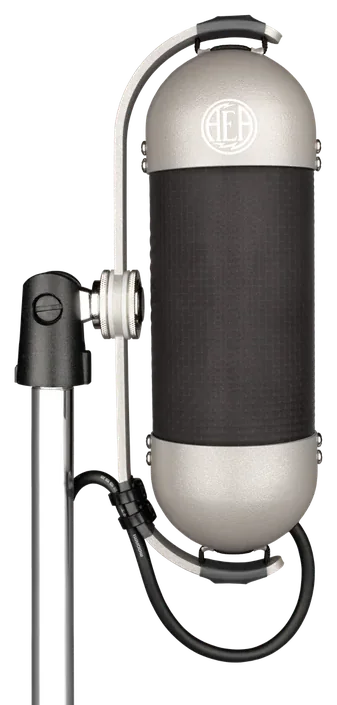
Audio Engineering Associates
AEA R92
Ribbon, figure-8 (large ribbon, passive), for close and medium distances; crisper front lobe than rear
Approximate Some readings for this mic are uncertain; see the graphs.
Power None (phantom not required or recommended). Switch phantom power off before you plug it in: a faulty cable can damage the ribbon. Low output: it needs a lot of preamp gain.
- Type
- Ribbon
- Pattern
- Figure-8
- Sensitivity
- −55 dBV/Pa
- Among 28 ribbons: more output than 19%
- Among 311 mics: more output than 13%
- Max SPL
- 165 dB SPL
- Among 29 ribbons: takes louder sound than 86%
- Among 343 mics: takes louder sound than 99%
- Rated range
- 20 – 20k Hz
vs 24 side-address ribbons
More output than 9% of 24 side-address ribbons.
Each stripe is one side-address ribbon with a published sensitivity, and each bar counts them; further right means more output. This mic is in blue.
vs 28 side-address ribbons
Takes louder sound than 85% of 28 side-address ribbons.
Each stripe is one side-address ribbon with a published max SPL, and each bar counts them; further right means it takes louder sound. This mic is in blue.
Instruments sources recommend it for most
Proximity effect: the bass it gains up close
From the spec sheet (Recording Hacks copy), p. 2.
"AEA R92 On-Axis Frequency Response (1m)", 200 Hz to 20 kHz, "Output Voltage (dBr)". Smoothing and lobe not stated. The 2005 manual (p. 4) and the 2018 spec sheet (p. 3) print the same curve.
Dashed: outside the rated range, or simulated (other angles and distances). Hover or tap the graphs for values.
Polar pattern
From the manual, p. 10. Approximate
"Directivity", full circle, 0° up, rings every 3 dB from +6 to -24 dB (CLIO). Measuring conditions not stated.
Approximate: reading error up to about 1 dB.
In practice
All specs
| From the manual | ||
|---|---|---|
| Capsule | pure aluminium corrugated ribbon, 1.8 µm thick, 4.7 mm wide, 59.7 mm long | p. 11 |
| Sensitivity | −55 dBV/Pa (1.8 mV/Pa)into an unloaded circuit. "1.8 mV/Pa (-55 dBV) into unloaded circuit". The 2005 one-sheet says "> -55 dBv/Pa". | |
| Max SPL | 165 dB SPLabove 1 kHz, 1% third harmonic; also 135 dB SPL, peak (2005 one-sheet and manual: ">135 dB SPL peak"). "165+ dB SPL (1% third harmonic > 1 kHz)". The 2005 one-sheet (p. 2) gives ">135 dB SPL peak". | |
| Output impedance | 270 ohmbroadband. "270 Ω Broadband"; the 2005 sheet says "nominal". | |
| Rated load impedance | 1200 ohmor greater. "1.2k Ω or greater". | |
| Rated frequency range | 20 Hz to 20 kHz-7 dB; also [20, 18000], ±3 dB (2005 one-sheet and manual). "<20 Hz to >20 kHz (-7dB)"; the spec sheet leaves out "(-7dB)". The 2005 one-sheet: "20 Hz to 18 kHz (+/- 3 dB)". | |
| Powering | none (phantom not required or recommended) | |
| Connector | XLR-3M on a 3 m (10') captive cable"XLR-3M wired to a 10' (3 m) captive cable". The spec sheet prints 10” (inches); the 2005 one-sheet had a 2 m cable. | |
| Weight | 893 g"1.97 lb (893 g)"; the shipping weight is given as "2 lbs (0.9 kg)", nearly the same, so it is unclear whether 893 g is the mic alone. The 2005 sheet: "2 pounds with cable and storage case". | |
| Dimensions | 191 × 74 × 64 mmHeight 7.5 in (19.1 cm), width 2.9 in (7.4 cm, with the stand adapter), depth 2.5 in (6.4 cm). | |
| Supplied accessories | storage/shipping case; user manual; soft cloth bag | |
| Ribbon tuning | 16.5 Hz (the same Big Ribbon, tuning and transformer as the R44) | p. 4 |
| Front and rear lobes | Front (AEA emblem) is the "crisp" side with clean high-end detail; rear is the "smooth" side with the classic ribbon high-frequency roll-off | p. 8 |
| Working distance | A near-field ribbon: flat response at 6-12 in (15-30 cm) from the source (p. 4); p. 10 says flat at 24 in (60 cm) | p. 4 |
| Off-axis response | Horizontal: up to 90 dB rejection at right angles to the front/back axis. Vertical: level changes with angle of incidence, but frequency response is consistent | p. 11 |
| Polarity | Pin 2 high for positive pressure on the front of the mic | |
| Mounting | Integrated 360° swivel on a C-shaped yoke, with an elastic shock-mount suspension | p. 7 |
| Preamp | Clean, high-impedance preamp with at least 1.2 kΩ input impedance and 65 dB of gain recommended | p. 5 |
| Wind protection | Multi-layered screens and grille cloths | p. 7 |
| Assembly | Handcrafted in Pasadena, California | p. 2 |
Documents
- AEA R92 Owner's Manual2022 V3
- AEA R92 Specificationsclassic near-field ribbon mic
- AEA R92 Studio Ribbon Microphonetechnical one-sheet 1.1
- AEA R92 Ribbon Microphone User’s Manual1.2
Copies kept by Mic Archive (manufacturers move and drop their documents). Each is © Audio Engineering Associates, unchanged, with its original address.
Recommended for
By recording guides, engineers and mic makers, for this mic or an earlier version of it.