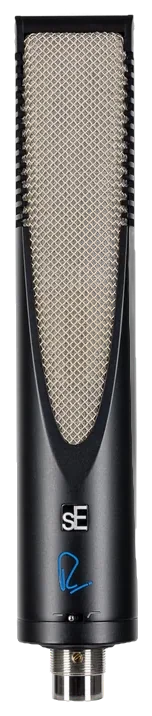
sE Electronics
sE RNR1
Active ribbon, figure-8, co-designed with Rupert Neve, with a switchable low-cut filter
Approximate Some readings for this mic are uncertain; see the graphs.
Power P48.
- Type
- Ribbon
- Pattern
- Figure-8
- Sensitivity
- −32 dBV/Pa
- Among 28 ribbons: more output than 96%
- Among 311 mics: more output than 88%
- Self-noise
- 17 dB(A)
- Max SPL
- 137 dB SPL
- Among 29 ribbons: takes louder sound than 46%
- Among 343 mics: takes louder sound than 46%
- Rated range
- 20 – 20k Hz
- Released
- 2009
vs 24 side-address ribbons
More output than 96% of 24 side-address ribbons.
Each stripe is one side-address ribbon with a published sensitivity, and each bar counts them; further right means more output. This mic is in blue.
vs 272 mics
Quieter than 41% of 272 mics.
Each stripe is one mic with a published self-noise, and each bar counts them; further right means quieter. This mic is in blue.
vs 28 side-address ribbons
Takes louder sound than 44% of 28 side-address ribbons.
Each stripe is one side-address ribbon with a published max SPL, and each bar counts them; further right means it takes louder sound. This mic is in blue.
Proximity effect: the bass it gains up close
From the manual, p. 8.
Titled "Frequency response"; distance, anechoic or not, smoothing and typical-vs-individual not stated. Relative dB.
Dashed: outside the rated range, or simulated (other angles and distances). Hover or tap the graphs for values.
Polar pattern
From the manual, p. 8. Approximate
"Polar Pattern". Two halves: 125 Hz to 2 kHz on the left, 4 to 16 kHz on the right; 0° at the top, 5 dB per ring labelled +5 to -25 dB; front and rear lobes drawn alike. Measuring conditions not stated.
Approximate: reading error up to about 1 dB.
In practice
All specs
| From the manual | ||
|---|---|---|
| Capsule | hand-tensioned 2.5 µm aluminium ribbon; neodymium magnetsMagnets: page 2 ("top-grade Neodymium magnets"). | p. 8 |
| Sensitivity | −32 dBV/Pa (25 mV/Pa)Printed "25 mV/Pa (-32 dB)". | |
| Self-noise | 17 dB(A)"Self noise: 17 dB(A)". | |
| Max SPL | 137 dB SPL0.5% THD @ 1 kHz | |
| Signal-to-noise ratio | 77 dBReference not stated. | |
| Output impedance | 200 ohmelectrical impedance | |
| Rated frequency range | 20 Hz to 20 kHz"Frequency range: 20 Hz – 20 kHz". Page 2 calls it the first ribbon mic whose response "extends all the way out to 25 kHz". | |
| Powering | P48"+48V phantom power". | |
| Low cut | off, 100 Hz; 100 Hz"Low cut filter switch: 100 Hz"; slope not stated. | |
| Connector | XLR-3 male"Matching Connectors: XLR3F", so the mic has a male XLR-3. | |
| Weight | 860 g"860g / 30.34oz". | |
| Dimensions | 47 × 268 mm"47mm (diameter) x 268mm (height)". | |
| Supplied accessories | Custom shock mount; Wooden box; Metal case; Thread adapter; User manual"What's in the box". | p. 4 |
| Electronics | Class-A discrete circuit designed by Rupert Neve Designs, with a custom Rupert Neve transformer between ribbon and amplifier and a second one on the output | p. 2 |
| From the Recording Hacks page | ||
| Released | 2009 | |
Documents
- sE Rupert Neve Signature Series User ManualRNR1, RN17, RNT; v9-3
- SE Electronics RNR1 | RecordingHacks.com
Copies kept by Mic Archive (manufacturers move and drop their documents). Each is © sE Electronics, unchanged, with its original address.
Recommended for
By recording guides, engineers and mic makers, for this mic or an earlier version of it.