sE Electronics
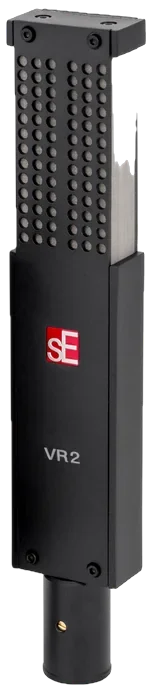
sE VR2
Active ribbon, figure-8, compact (the phantom-powered version of the VR1)
Power P48.
- Type
- Ribbon
- Pattern
- Figure-8
- Sensitivity
- −37 dBV/Pa
- Among 28 ribbons: more output than 85%
- Among 311 mics: more output than 66%
- Self-noise
- 18 dB(A)
- Max SPL
- 135 dB SPL
- Among 29 ribbons: takes louder sound than 25%
- Among 343 mics: takes louder sound than 36%
- Rated range
- 20 – 18k Hz
vs 24 side-address ribbons
More output than 83% of 24 side-address ribbons.
Each stripe is one side-address ribbon with a published sensitivity, and each bar counts them; further right means more output. This mic is in blue.
vs 272 mics
Quieter than 32% of 272 mics.
Each stripe is one mic with a published self-noise, and each bar counts them; further right means quieter. This mic is in blue.
vs 28 side-address ribbons
Takes louder sound than 22% of 28 side-address ribbons.
Each stripe is one side-address ribbon with a published max SPL, and each bar counts them; further right means it takes louder sound. This mic is in blue.
Instruments sources recommend it for most
Proximity effect: the bass it gains up close
From the manual, p. 4.
"Frequency Response", printed once for the VR1 and VR2 (not said which was measured). Relative dB; distance, room, smoothing and typical-vs-individual are not stated.
Dashed: outside the rated range, or simulated (other angles and distances). Hover or tap the graphs for values.
Polar pattern
From the manual, p. 4.
"Polar Pattern", printed once for the VR1 and VR2. 0° up; each frequency drawn on one half (125 Hz to 1 kHz on the left, 2 to 16 kHz on the right), front and rear lobes drawn alike. Measuring conditions not stated.
In practice
All specs
| From the manual | ||
|---|---|---|
| Capsule | hand-tensioned 2.5 µm aluminium ribbon; neodymium magnet | p. 3 |
| Sensitivity | −37 dBV/Pa (14.1 mV/Pa)Printed "14.1 mV/Pa (-37 dB)". | |
| Self-noise | 18 dB(A)"Equivalent Noise Level: 18 dB(A)". | |
| Max SPL | 135 dB SPL0.5% THD @ 1 kHz | |
| Signal-to-noise ratio | 76 dBReference not stated. | |
| Dynamic range | 117 dB | |
| Output impedance | 200 ohmelectrical impedance | |
| Rated load impedance | 1000 ohmgreater than. "Recommended Load Impedance: >1k Ohms". | |
| Rated frequency range | 20 Hz to 18 kHz"Frequency Range: 20 – 18,000 Hz"; no tolerance given. | |
| Powering | P48"+48V Phantom" (page 4); "requires a phantom power source providing 48 Volts according to IEC 61938". | |
| Current draw | 2.4 mA | p. 4 |
| Connector | XLR-3 male | |
| Weight | 321 galso 360 g, earlier manual (v1-9-00). "321 g (11.32 oz.)". The v1-9-00 manual (Full Compass copy, page 4) gives "360 g (12.70 oz)". | |
| Dimensions | 33 × 17 × 187 mmPrinted "33 mm (1.30 in.) x 17 mm (0.67 in.) x 187 mm (7.36 in.)": width x depth x length. The v1-9-00 manual gives 19.5 mm for the depth. | |
| Supplied accessories | Windscreen; Microphone clip; Thread adapter; Soft case; Shock mount"What's in the box". The v1-9-00 manual lists a stand clip, thread adapter, wooden case and shock mount. | p. 2 |
| Design | A mechanical device extends the high-frequency response "approaching nearly 20kHz"; handles high SPL (loud brass, drums, guitar cabinets); suited to acoustic instruments, piano and vocals | |
Documents
- VR1 VR2 User Manualv2-2
- VR1 VR2 User Manualv1-9-00
Copies kept by Mic Archive (manufacturers move and drop their documents). Each is © sE Electronics, unchanged, with its original address.
Recommended for
By recording guides, engineers and mic makers, for this mic or an earlier version of it.