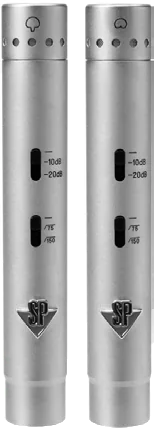
Studio Projects
Studio Projects C4
Small-diaphragm (20 mm) condenser pencil mic with screw-on omni, cardioid and hypercardioid capsules; sold as a matched pair
Approximate Some readings for this mic are uncertain; see the graphs.
Power P48 ±4 V phantom.
- Type
- Condenser
- Pattern
- Switchable, 3
- Sensitivity
- −39 dBV/Pa
- Among 204 condensers: more output than 42%
- Among 311 mics: more output than 59%
- Self-noise
- 18 dB(A)
- Among 258 condensers: quieter than 33%
- Among 272 mics: quieter than 32%
- Max SPL
- 158 dB SPL
- Among 277 condensers: takes louder sound than 99%
- Among 343 mics: takes louder sound than 97%
- Rated range
- 20 – 20k Hz
- Released
- 2003
vs 75 end-address condensers
More output than 34% of 75 end-address condensers.
Each stripe is one end-address condenser with a published sensitivity, and each bar counts them; further right means more output. This mic is in blue.
vs 104 end-address condensers
Quieter than 34% of 104 end-address condensers.
Each stripe is one end-address condenser with a published self-noise, and each bar counts them; further right means quieter. This mic is in blue.
vs 110 end-address condensers
Takes louder sound than 100% of 110 end-address condensers.
Each stripe is one end-address condenser with a published max SPL, and each bar counts them; further right means it takes louder sound. This mic is in blue.
Instruments sources recommend it for most
Proximity effect: the bass it gains up close
From the graph cardioid rh, p. 1.
Recording Hacks' "Studio Projects C4 Frequency Chart: Cardioid" (CC1 cardioid capsule); relative dB. Distance, room and smoothing not stated.
Dashed: outside the rated range, or simulated (other angles and distances). Hover or tap the graphs for values.
Polar pattern
From the graph cardioid rh, p. 1. Approximate
Polar plot on the same image: two half-discs, 250 Hz to 2 kHz on the left and 4 to 16 kHz on the right, each taken as symmetric; 5 dB per ring, the outer ring 0 dB. Measuring conditions not stated.
Approximate: reading error up to about 1 dB.
In practice
All specs
| From the manual (Recording Hacks copy) | ||
|---|---|---|
| Capsule | 20 mm, screw-on heads: OC1 omni (pressure), CC1 cardioid and HC1 hypercardioid (pressure gradient)"Omni-directional pressure (OC1 head), pressure gradient cardioid (CC1 head), pressure gradient hypercardioid (optional HC1 head)"; the pair comes with two omni and two cardioid capsules (p. 3). | p. 6 |
| Sensitivity | −39 dBV/PaOC1 omni and CC1 cardioid capsules; also −38 dBV/Pa, HC1 hypercardioid capsule. "Sensitivity: -39dB/-39dB/-38dB", in the order of the patterns (omni, cardioid, hypercardioid); reference not printed, taken as dB re 1 V/Pa (the LSD2 beside it: "12mV/Pa=-38dB(0dB=1V/Pa)"). Recording Hacks lists 11 mV/Pa (-39.2 dBV/Pa) for each capsule. | |
| Self-noise | 18 dB(A)A-weighted per IEC 268-15; also 16 dB(A), Recording Hacks, for the 2006 revision. "Equivalent Noise: 18 dB SPL, (A-weighted per IEC268-15)". Recording Hacks says the 2006 revision has "2dB lower noise (from 18dBA to 16dBA)", yet this 2007 manual still gives 18. | |
| Max SPL | 158 dB SPLwith the -20 dB pad. "Max SPL: 158 dB SPL with -20dB pad"; no figure without the pad. | |
| Signal-to-noise ratio | 76 dBOC1 and CC1 capsules; also 77 dB, HC1 capsule. "S/N ratio: 76/76/77dB". | |
| Output impedance | 200 ohmless than ("<200 Ohm") | |
| Rated load impedance | 1200 ohmmore than (">1200 Ohm") | |
| Rated frequency range | 20 Hz to 20 kHz"20Hz – 20kHz"; the graphs are drawn from 50 Hz. | |
| Powering | P48 ±4 V phantom"P48 +/- 4V". | |
| Current draw | 3.1 mA"Current consumption: 3.1ma". | |
| Low cut | off, 75 Hz, 150 Hz; 6 dB/octave"Low cut: 6 dB/Octave at 75Hz/150Hz"; a three-way switch on the body (p. 3: "150Hz setting will attenuate low frequencies by 6dB/octave starting at 150Hz"). | |
| Pad | −10 dBalso −20 dB. "Pad: -10dB/-20dB"; it "reduces the signal level between the capsule and the circuitry" (p. 3). | |
| Connector | XLR-3, gold-plated | |
| Weight | 92 g"3.3oz. (92g)". | |
| Dimensions | 124.5 × 20 mmLength 124.5 mm ("4.90''"), diameter 20 mm. | |
| Supplied accessories | mic stand clips C4SC; foam windscreens C4WS; stereo bar SPSB; hard-shell carrying case"offered in pairs with mic stand clips (C4SC), foam windscreens (C4WS), stereo bar (SPSB) and hard shell carrying case". | |
| Circuit | JFET follower, low-distortion output buffer; transformerless | |
| Sold as | Matched pair, with two omni and two cardioid capsules | p. 3 |
| Changing capsules | Screw off and on; best done unplugged or with the level down (it makes "a horrendous noise") | |
| Made by | Beijing 797 Audio Co. for PMI Audio Group (Gardena, California) | p. 2 |
| Usesmaker | Omni: ambience (especially in pairs), vocal, piano, orchestral; cardioid: close miking, X-Y and ORTF pairs, drum overheads, toms, snare; hypercardioid: X-Y, ORTF, speech and dialogue, overheads, spot miking | p. 6 |
| From the rh page | ||
| Released | 2003 | p. 1 |
| Revision | Redesigned in 2006 by Brent Casey of PMI Audio: new amplifier circuit, higher sensitivity, lower noise, and a hypercardioid capsule added | |
Documents
- Studio Projects C Series Microphones, Instruction ManualC1, C3, T3, C4, LSD2
- Studio Projects C4 frequency chart: cardioidRecording Hacks image
- Studio Projects C4 frequency chart: omnidirectionalRecording Hacks image
- Studio Projects C4 | RecordingHacks.com


Copies kept by Mic Archive (manufacturers move and drop their documents). Each is © Studio Projects, unchanged, with its original address.
Recommended for
By recording guides, engineers and mic makers, for this mic or an earlier version of it.