Austrian Audio
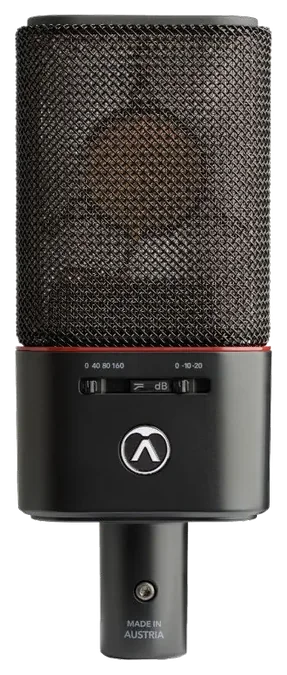
Austrian Audio OC18
Large-diaphragm cardioid condenser with ceramic capsule, three-step low cut and two-step pad
Approximate Some readings for this mic are uncertain; see the graphs.
Power Phantom 48 V.
- Type
- Condenser
- Pattern
- Cardioid
- Sensitivity
- −37.7 dBV/Pa
- Among 204 condensers: more output than 49%
- Among 311 mics: more output than 65%
- Self-noise
- 9 dB(A)
- Among 258 condensers: quieter than 86%
- Among 272 mics: quieter than 87%
- Max SPL
- 148 dB SPL
- Among 277 condensers: takes louder sound than 88%
- Among 343 mics: takes louder sound than 87%
- Rated range
- 20 – 20k Hz
vs 75 side-address condensers
More output than 34% of 75 side-address condensers.
Each stripe is one side-address condenser with a published sensitivity, and each bar counts them; further right means more output. This mic is in blue.
vs 99 side-address condensers
Quieter than 69% of 99 side-address condensers.
Each stripe is one side-address condenser with a published self-noise, and each bar counts them; further right means quieter. This mic is in blue.
vs 107 side-address condensers
Takes louder sound than 88% of 107 side-address condensers.
Each stripe is one side-address condenser with a published max SPL, and each bar counts them; further right means it takes louder sound. This mic is in blue.
Proximity effect: the bass it gains up close
From the graph response, p. 1.
Titled "OC 18 Cardioid". Distance, room and smoothing not stated.
Dashed: outside the rated range, or simulated (other angles and distances). Hover or tap the graphs for values.
Polar pattern
From the graph polar, p. 1. Approximate
Full circle, 0° at the top, 5 dB per ring from +5 to -25 dB; low frequencies drawn on the left half (solid), high ones on the right (dashed). Measuring conditions not stated.
Approximate: reading error up to about 1 dB; some frequencies are identified by reasoning, not by the legend: 250 Hz, 500 Hz.
In practice
All specs
| From the spec sheet | ||
|---|---|---|
| Capsule | large diaphragm, ceramic capsule"the unique ceramic capsule design"; "identical acoustic characteristics as its big brother the OC818". | p. 1 |
| Sensitivity | −37.7 dBV/Pa (13 mV/Pa)Stated as "Sensitivity (all directions): 13mV/Pa"; converted: 20·log10(0.013) = -37.7. | |
| Self-noise | 9 dB(A)"Equivalent noise level: 9 dB SPL (A)". | |
| Max SPL | 148 dB SPLalso 158 dB SPL, in brackets on the sheet; presumably with the pad. "Max SPL: 148 dB SPL (158 dB SPL)"; the sheet does not say what the bracketed figure is. The manual (p. 2): the -10 dB pad position "reduces the bias voltage of the capsule, so the microphone can take 10 dB more input". | |
| Output impedance | 275 ohmbalanced. "Impedance: 275 Ω (symmetrical)". | |
| Rated load impedance | 1000 ohmmore than. "Load impedance: > 1 kΩ". | |
| Rated frequency range | 20 Hz to 20 kHz"Frequency range: 20 Hz - 20 kHz"; tolerance not stated. | |
| Connector | XLR-3 male"Main Connector: XLR 3 pin". | |
| Weight | 335 g"Weight: 335 g". | |
| Dimensions | 157 × 63 × 35 mm"Dimensions: 157 x 63 x 35 mm"; which dimension is which is not stated (presumably height × width × depth). | |
| Supplied accessories | protective carry case; OCS8 spider mount suspension; OCW8 foam windshield; OCH8 mic clipThe "OC18 Studio Set". The "OC18 Live Set" is two OC18 with two OCW8 windshields and two OCH8 clips. | p. 2 |
| Matching | Any OC18 can be paired with any other OC18, or with an OC818 set to cardioid | p. 1 |
| From the manual | ||
| Powering | phantom 48 V"phantom power source of 48V (+/-4V), max draw is 2.2mA"; page 2: "according to P48 (48V +/- 4V)". The spec sheet: "Supply voltage: 48 V (< 2.2mA)". | p. 1 |
| Current draw | 2.2 mAmaximum (peak). "max draw is 2.2mA"; page 2: "Peak current consumption is below 2.2 mA". | |
| Low cut | off, 40 Hz, 80 Hz, 160 Hz; high-passSwitch positions "0", "40", "80", "160": "40" and "80" are 2nd-order high-pass filters; "160 is a high pass 1st order filter from 160 Hz to 80 Hz, and a high pass 2nd order filter below 80 Hz". The spec sheet says the same. | p. 2 |
| Pad | −10 dBalso −20 dB. Switch positions "0", "-10", "-20". "The -10 dB position reduces the bias voltage of the capsule ... whereas the -20 dB Setting reduces the gain by another 10 dB to protect your mixer preamp from overload." | |
| Front | The side with the logo faces the source | |
| Operating temperature | 0 to 55 °C (storage -25 to 60 °C) | p. 1 |
| Cable length | XLR cable no longer than 30 m | |
| Made in | Austria | p. 2 |
| From the quick guide | ||
| Calibration | Factory calibrated, ±0.5 dB at 1 kHz | p. 2 |
| Acoustics | "Open acoustics technology" | |
Documents
- OC18 Large-diaphragm Condenser Microphonespec sheet, v1.3
- OC18 Large-Diaphragm Condenser Microphone with Cardioid Polar Pattern, Owner's Manualv02
- OC18 Quick Start Guide18005R00100_C
- OC18 Cardioid frequency chartimage on the product page
- OC18 polar plotimage on the product page


Copies kept by Mic Archive (manufacturers move and drop their documents). Each is © Austrian Audio, unchanged, with its original address.
Recommended for
By recording guides, engineers and mic makers, for this mic or an earlier version of it.