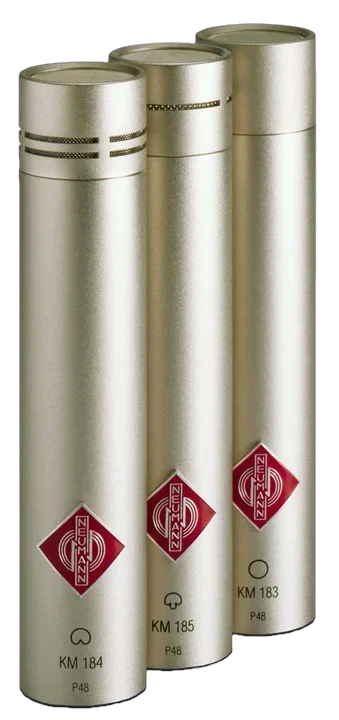
Neumann
Neumann KM 184
Small-diaphragm condenser, cardioid
Power Phantom P48, 48 V ± 4 V (IEC 1938).
- Type
- Condenser
- Pattern
- Cardioid
- Sensitivity
- −36.5 dBV/Pa
- Among 204 condensers: more output than 57%
- Among 311 mics: more output than 70%
- Self-noise
- 13 dB(A)
- Among 258 condensers: quieter than 67%
- Among 272 mics: quieter than 68%
- Max SPL
- 138 dB SPL
- Among 277 condensers: takes louder sound than 53%
- Among 343 mics: takes louder sound than 49%
- Rated range
- 20 – 20k Hz
- Released
- 1993
vs 75 end-address condensers
More output than 54% of 75 end-address condensers.
Each stripe is one end-address condenser with a published sensitivity, and each bar counts them; further right means more output. This mic is in blue.
vs 104 end-address condensers
Quieter than 79% of 104 end-address condensers.
Each stripe is one end-address condenser with a published self-noise, and each bar counts them; further right means quieter. This mic is in blue.
vs 110 end-address condensers
Takes louder sound than 53% of 110 end-address condensers.
Each stripe is one end-address condenser with a published max SPL, and each bar counts them; further right means it takes louder sound. This mic is in blue.
Instruments sources recommend it for most
5 of 29; all under Recommended for.
Proximity effect: the bass it gains up close
From the manual (Recording Hacks copy), p. 5.
Free field, IEC 60268-4 (as printed on the page). Distance not stated. The solid curve is the nominal response; the dashed lines are its tolerance band.
Dashed: outside the rated range, or simulated (other angles and distances). Hover or tap the graphs for values.
Polar pattern
From the manual (Recording Hacks copy), p. 5.
Free field, IEC 60268-4. Each curve is drawn on one side only (125 Hz and 250 to 1000 Hz left, 2 to 16 kHz right); the pattern is taken as symmetric.
In practice
All specs
| From the manual (Recording Hacks copy) | ||
|---|---|---|
| The table lists KM 183/KM 184/KM 185; this is the middle value. | ||
| Sensitivity | −36.5 dBV/Pa (15 mV/Pa)1 kHz into 1 kohm; ± 1 dB. Stated as 15 mV/Pa; converted: 20·log10(0.015) = -36.5. | p. 4 |
| Self-noise | 13 dB(A)IEC 61672-1 A-weighting, RMS. | |
| Self-noiseCCIR 468 | 22 dBCCIR 468-3, quasi peak. | |
| Max SPL | 138 dB SPL0.5% THD. THD of the mic amplifier at an input equal to the capsule output at that SPL. | |
| Signal-to-noise ratio | 81 dBre 94 dB SPL, A-weighted; also 72 dB, re 94 dB SPL, CCIR 468-3. | |
| Dynamic range | 122 dB"from app. 13 dB-A to app. 138 dB SPL" (series description; the 138 dB is the KM 184 figure). | p. 2 |
| Output impedance | 50 ohmrated impedance | p. 4 |
| Rated load impedance | 1000 ohmrated load impedance | |
| Rated frequency range | 20 Hz to 20 kHzTolerance not stated in the table; the response graph shows a band of about ± 2 dB. | |
| Powering | phantom P48, 48 V ± 4 V (IEC 1938) | |
| Current draw | 3.2 mA | |
| Connector | XLR-3 maleMatching connector XLR 3F (p. 4); pin 2 hot. | p. 2 |
| Weight | 80 gapprox. | p. 4 |
| Dimensions | 22 × 107 mmDiameter × length. | |
| Finish | nickel (ni) or matte black (mt) | p. 2 |
| Supplied accessories | SG 21 bk swivel mount; WNS 100 windscreen (black)The 2008 catalog (p. 3) says two stand mounts (SG 21/17 mt) and the WNS 100. | |
| Max. output voltage | 10 dBu | p. 4 |
| Cat. No. | KM 184 (nickel) 08439; KM 184 mt (black) 08389 | p. 2 |
| Pin assignment | Pin 1: 0 V/ground; Pin 2: Modulation (+phase); Pin 3: Modulation (–phase) | |
| Off-axis response | Signals within a pick-up angle of ± 135° are reproduced without any coloration | |
| Battery operation | At least 20 hours on a BS 48 i battery unit | p. 3 |
| From the catalog (Recording Hacks copy) | ||
| Capsule | small-diaphragm pressure-gradient capsule; same capsule as the KM 84 with a changed rear opening | p. 3 |
| Stereo set Cat. No. | KM 184 008524; KM 184 mt 008523 | |
| 0° response | Gentle rise at about 9 kHz (compared with the KM 84), from a change of the capsule's rear opening | |
| Optional accessories | EA 2124 A mt elastic suspension; MNV 21 mt auditorium hanger; PS 15 popscreen; WS 100 windscreen | |
| Applications | Universal; XY and ORTF stereo pair; announcer mic; spot mic, overhead; close miking of strings, wind, percussion, piano, Leslie speakers, guitar amps | p. 6 |
| From the Recording Hacks page | ||
| Released | 1993 | |
Documents
- Series 180 user manualKM 183, KM 184, KM 185
- Series 180 product catalog
- KM 184 frequency response graphNeumann artwork file, 2017
- KM 184 polar pattern graphNeumann artwork file, 2017
- Neumann KM 184 | RecordingHacks.com
Copies kept by Mic Archive (manufacturers move and drop their documents). Each is © Neumann, unchanged, with its original address.
Recommended for
By recording guides, engineers and mic makers, for this mic or an earlier version of it.
- Acoustic guitar
- Bansuri
- Barbershop quartet
- Bodhrán and frame drum
- Didgeridoo
- Drum kit
- Duduk
- Erhu
- Gamelan
- Gospel choir
- Hammond organ and Leslie speaker
- Handpan
- Harp
- Hurdy-gurdy
- Koto
- Mandolin
- Mixed choir (SATB)
- Oud
- Pipe organ
- Recorder
- Resonator guitar
- Shaker
- Shamisen
- Steel guitar
- Steelpan
- String section
- Tam-tam
- Timbales
- Tubular bells
Other mics
More from Neumann
- Neumann U 87 (U 87 i)
- Neumann KM 84
- Neumann TLM 103
- Neumann U 47
- Neumann U 67
- Neumann U 47 fet
- Neumann TLM 170 R
- Neumann TLM 102