Georg Neumann GmbH
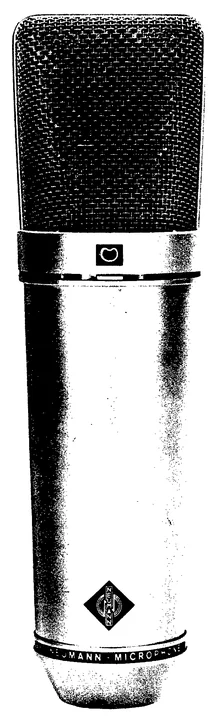
Neumann U 87 (U 87 i)
Large-diaphragm condenser (FET, transformer output) with three patterns (omni, cardioid, figure-8); the original U 87 and the U 87 i, before the U 87 Ai
Approximate Some readings for this mic are uncertain; see the graphs.
Power Phantom, 48 V ± 4 V (P48, DIN 45 596); or two internal batteries.
- Type
- Condenser
- Pattern
- Switchable, 3
- Sensitivity
- −41.9 dBV/Pa
- Among 204 condensers: more output than 28%
- Among 311 mics: more output than 49%
- Self-noise
- 18 dB(A)
- Among 258 condensers: quieter than 33%
- Among 272 mics: quieter than 32%
- Max SPL
- 122 dB SPL
- Among 277 condensers: takes louder sound than 8%
- Among 343 mics: takes louder sound than 6%
- Rated range
- 40 – 16k Hz
- Released
- 1967
vs 75 side-address condensers
More output than 11% of 75 side-address condensers.
Each stripe is one side-address condenser with a published sensitivity, and each bar counts them; further right means more output. This mic is in blue.
vs 99 side-address condensers
Quieter than 13% of 99 side-address condensers.
Each stripe is one side-address condenser with a published self-noise, and each bar counts them; further right means quieter. This mic is in blue.
vs 107 side-address condensers
Takes louder sound than 12% of 107 side-address condensers.
Each stripe is one side-address condenser with a published max SPL, and each bar counts them; further right means it takes louder sound. This mic is in blue.
Instruments sources recommend it for most
5 of 30; all under Recommended for.
Proximity effect: the bass it gains up close
From the manual, p. 10.
"Frequency Response and Polar Patterns", omni graph; relative dB as printed, with a tolerance band (dashed, not read) and the curve crossing an X at 1 kHz. Distance, room and smoothing not stated.
Dashed: outside the rated range, or simulated (other angles and distances). Hover or tap the graphs for values.
Polar pattern
From the manual, p. 11. Approximate
Omni polar plot (page 11), 0° at the top, rings every 5 dB; legend "125 Hz, 4 kHz, 8 kHz ≡ 1 kHz". Measuring conditions not stated.
Approximate: reading error up to about 1 dB.
In practice
All specs
| From the manual | ||
|---|---|---|
| Sensitivity | −41.9 dBV/Pa (8 mV/Pa)1 kHz; ±1 dB. Printed "8 mV/Pa ±1 dB"; converted with 20·log10(0.008 V). Pattern not stated. The brochure gives the original U 87 as "approx. 0.8 mV/µb" (the same, 8 mV/Pa; p. 4). | p. 9 |
| Self-noise | 18 dB(A)IEC 179, DIN 45 634. "A-weighted equivalent loudness level due to inherent noise (IEC 179, DIN 45 634): 18 dB". The weighted figure per DIN 45 590 (25 dB) is in the extra specs. | |
| Max SPL | 122 dB SPL0.5% THD at 1 kHz; also 132 dB SPL, with sensitivity reduction (pad). "Max. SPL for 0.5% THD at 1 kHz: 122 dB ≙ 25 Pa; with sensitivity reduction 132 dB ≙ 79 Pa". The brochure gives the original U 87 as 126 dB (extra specs). | |
| Signal-to-noise ratio | 69 dBDIN 45 590, ref. level 1 Pa. "S/N ratio according to DIN 45 590 (ref. level 1 Pa): 69 dB" (94 dB minus the 25 dB weighted noise level). | |
| Output impedance | 200 ohmstandard wiring; 50 ohm by re-soldering the transformer. "Source impedance: 200 ohms, solderable to 50 ohms". At 50 ohms the output drops by 6 dB (p. 4). | |
| Rated load impedance | 1000 ohmminimum, 200 ohm wiring; also 250 ohm, minimum, 50 ohm wiring. "Minimum load impedance: 1000 ohms/250 ohms". | |
| Rated frequency range | 40 Hz to 16 kHz"Frequency range: 40...16 000 Hz"; the same for the original U 87 in the brochure (p. 4). | |
| Powering | phantom, 48 V ± 4 V (P48, DIN 45 596); or two internal batteries"Power supply (P 48, DIN 45 596): 48 V ±4 V Phantom powering". Internal batteries: two IEC 15 F 15 cells (e.g. Mallory M-505) for over 150 hours, with an INT/EXT switch and a battery meter (p. 6). | |
| Current draw | 0.4 mA | |
| Low cut | off, onThird switch: "introduces a low frequency roll-off", set so that the cardioid response is flat at a talking distance of 30-40 cm and the figure-8 at 15-20 cm. Frequency and slope not stated. Separately, feedback at the FET gate attenuates below 30 Hz in all positions. | p. 2 |
| Pad | −10 dB"A second slider switch located on the rear of the microphone introduces a pre-attenuation of about 10 dB in the circuit." | |
| Connector | XLR-3 (U 87 i); 7-pole Binder/Tuchel (U 87)U 87 i: "male 3-pole connector insert" (XLR type), pin 2 hot. U 87 (special version): "large male 7-pole connector insert", wired per DIN 45 599 G. | p. 4 |
| Weight | 500 g"500 g (17.7 ozs.)". The brochure gives the original U 87 as 550 g (p. 4). | p. 9 |
| Dimensions | 200 × 56 mm"56 mm (2.2") in diam., 200 mm (7.9") long"; length × diameter. The same in the brochure (p. 4). | |
| Versions | U 87 i (XLR-3); U 87 (7-pole connector, "special version available until further notice"); U 87 i mt and U 87 mt (dark matt finish) | p. 4 |
| Transducer | Pressure gradient transducer; elastically suspended dual-membrane capsule | p. 9 |
| Equivalent noise, weightedDIN 45 590 | 25 dB | |
| Max. output voltage | 200 mV | |
| Battery operation | Two internal IEC 15 F 15 cells, over 150 hours; or the BS 945 i battery supply, at least 15 hours | p. 6 |
| Output | Output transformer with high common mode rejection and a static shield winding | p. 2 |
| Bass roll-off below 30 Hz | "A frequency-dependent feedback attenuates components below 30 Hz at the gate of the field effect transistor, while components above 40 Hz are transmitted unattenuated" | |
| ResponseNeumann | In the cardioid and figure-8 positions the response is "practically linear for perpendicular sound incidence, even in the upper audio frequency range" | |
| Cable length | Not more than 300 m | p. 5 |
| Accessories | IC 3 and IC 4 cables (U 87 i); KC 73, UC 73 and KT 1 cables (U 87); N 452 i mains supply; BS 945 i battery supply | p. 4 |
| From the catalog | ||
| Original U 87 (brochure): self-noise | Approx. 26 dB (DIN 45 405, re 2·10⁻⁴ µbar) | p. 4 |
| Original U 87 (brochure): max. SPL | 126 dB (≥ 400 µbar) for 0.5% THD | |
| Original U 87 (brochure): capsule capacitance | 2 × approx. 50 pF | |
| Original U 87 (brochure): supply | 48 V +6/−8 V DC, approx. 0.4 mA; batteries about 200 hours | |
| Original U 87 (brochure): weight | 550 g | |
| Original U 87 (brochure): features | Omni, cardioid and figure-of-eight; in cardioid the close-talking bass rise can be switched to "linear"; capsule sensitivity can be reduced ahead of the amplifier; room for batteries | p. 3 |
| From the Recording Hacks page | ||
| Released | 1967 | |
Documents
- Operating Instructions U 87 i (English and German), 09/1982
- neumann transistor condenser microphonesKM 73, KM 74, KM 75, U 77, KM 83, KM 84, KM 86, U 87
- Neumann U 87 | RecordingHacks.com
Copies kept by Mic Archive (manufacturers move and drop their documents). Each is © Georg Neumann GmbH, unchanged, with its original address.
Recommended for
By recording guides, engineers and mic makers, for this mic or an earlier version of it.
- A cappella group
- Banjo
- Bansuri
- Baritone saxophone
- Bodhrán and frame drum
- Clarinet
- Concertina
- Congas
- Diatonic button accordion
- Didgeridoo
- Drum kit
- Duduk
- Electric guitar
- Great Highland bagpipe
- Hammond organ and Leslie speaker
- Harmonica
- Harp
- Piano accordion
- Resonator guitar
- Saxophones
- Shaker
- Steelpan
- Tam-tam
- Tambourine
- Trombone
- Trumpet
- Tuba
- Tubular bells
- Violin
- Voice
Other mics
More from Neumann
- Neumann KM 184
- Neumann KM 84
- Neumann TLM 103
- Neumann U 47
- Neumann U 67
- Neumann U 47 fet
- Neumann TLM 170 R
- Neumann TLM 102