RØDE
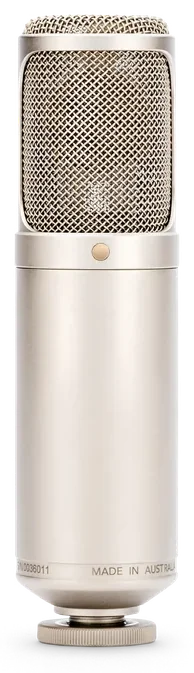
RØDE K2
Valve (tube) condenser, large diaphragm, continuously variable pattern from omni through cardioid to figure-8, side-address
Power Dedicated mains power supply (100-120 V / 200-240 V AC, 50/60 Hz).
- Type
- Condenser
- Pattern
- Switchable, 3
- Sensitivity
- −36 dBV/Pa
- Among 204 condensers: more output than 58%
- Among 311 mics: more output than 71%
- Self-noise
- 10 dB(A)
- Among 258 condensers: quieter than 81%
- Among 272 mics: quieter than 82%
- Max SPL
- 162 dB SPL
- Among 277 condensers: takes louder sound than 100%
- Among 343 mics: takes louder sound than 98%
- Rated range
- 20 – 20k Hz
- Released
- 2004
vs 75 side-address condensers
More output than 47% of 75 side-address condensers.
Each stripe is one side-address condenser with a published sensitivity, and each bar counts them; further right means more output. This mic is in blue.
vs 99 side-address condensers
Quieter than 61% of 99 side-address condensers.
Each stripe is one side-address condenser with a published self-noise, and each bar counts them; further right means quieter. This mic is in blue.
vs 107 side-address condensers
Takes louder sound than 100% of 107 side-address condensers.
Each stripe is one side-address condenser with a published max SPL, and each bar counts them; further right means it takes louder sound. This mic is in blue.
Instruments sources recommend it for most
Proximity effect: the bass it gains up close
From the spec sheet, p. 2.
Titled by pattern ("Cardiod", "Omni"); relative dB, 0 dB at the heavier gridline. Distance, room and smoothing not stated.
That unit is from the Multi-Angle, Multi-Distance Microphone Impulse Response Dataset (CC BY 4.0), measured at 1.25 m and set to 0 dB at 1 kHz, from 136 Hz up. Not the manufacturer's curve.
Dashed: outside the rated range, or simulated (other angles and distances). Hover or tap the graphs for values.
Polar pattern
From the spec sheet, p. 2.
Titled by pattern ("Cardiod", "Figure 8", "Omni"); full circle, the halves folded. Scale bar +5.0 to -25.0 "dB rel. 1V/Pa" (the lines sit at 0 dB on axis). Measuring conditions not stated.
In practice
All specs
| From the manual | ||
|---|---|---|
| Self-noise | 10 dB(A)per IEC 651, IEC 268-15. "10dBA SPL (per IEC651, IEC268-15)"; the data sheet says "10 dBA". | p. 3 |
| Max SPL | 162 dB SPL1 kHz, 1% THD into 1 kΩ. The data sheet says "162dB SPL". | |
| Signal-to-noise ratio | 81 dB">81dB SPL", 1 kHz, rel 1 Pa, per IEC 651. Stated as a minimum: ">81dB SPL (@ 1kHz, rel 1Pa per IEC651)". | |
| Dynamic range | 150 dBper IEC 651; also 95 dB, data sheet: "95 dBA Typical". "150dB (per IEC651)". The 2024 data sheet says "95 dBA Typical"; neither matches 162 dB minus 10 dB(A) = 152 dB. | |
| Powering | dedicated mains power supply (100-120 V / 200-240 V AC, 50/60 Hz)"Dedicated power supply (100-120V / 200-240V AC 50/60Hz)"; voltage selector 115 V / 230 V, fuse T500mA (p. 6). | |
| Connector | 7-pin to the power supply; XLR-3 output on the power supply7-pin K2 cable from the mic to the power supply's input, XLR output on its back (pp. 6-7). Data sheet: "Power Supply Output Connection: 3-pin XLR". | p. 7 |
| Electronics | Class A valve circuitry; valve/tube impedance converter with bipolar output buffer | p. 3 |
| Maximum output | >+30 dBu (1 kHz, 1% THD into 1 kΩ) | |
| Pattern control | Continuously variable dial on the front of the power supply: omni fully anticlockwise, cardioid at 12 o'clock, figure-8 fully clockwise | p. 8 |
| Power supply | Front: power switch, pattern dial, blue power LED. Back: 7-pin mic input, XLR output, ground lift, voltage selector (115/230 V), mains socket with fuse | p. 6 |
| Warm-up | "allow a minute or two to allow the microphone to stabilise" | p. 7 |
| RF rejection | High level of RF rejection | p. 5 |
| Made in | Designed and manufactured in Australia | |
| From the spec sheet | ||
| Capsule | 1" large diaphragm, gold-sputtered, dual-diaphragm (pressure gradient)"Large 1" gold-sputtered diaphragm"; "Acoustic Principle: Pressure gradient". The manual says "Pressure, Pressure gradient" and "gold-plated diaphragm" (pp. 3, 5); the 2009 sheet's title says "Dual 1" Condenser". | p. 1 |
| Sensitivity | −36 dBV/Pa (16 mV/Pa)1 kHz, ±2 dB; also −37 dBV/Pa, 2009 data sheet ("-37dB re 1V/Pa (14mV @ 94dB SPL)"). "-36.0dB re 1 Volt/Pascal (16.00mV @ 94 dB SPL) +/- 2 dB @ 1kHz", as in the manual. | |
| Output impedance | 200 ohm | |
| Rated frequency range | 20 Hz to 20 kHz"20Hz - 20kHz". | |
| Weight | 815 g"Weight (grams): 815", as in the manual ("Net Weight: 815g"). The 2009 sheet says "Net Weight 1440g". | p. 2 |
| Dimensions | 208 × 55 mmalso [201, 55], the data sheet's dimension drawing; also [201, 65], 2009 data sheet. "Length: 208, Diameter: 55": length × diameter. The manual says "208 x 55 x 55mm"; the dimension drawing on the same page says 201 mm and 55 mm. | |
| Supplied accessories | SM6 shock mount and pop filter; power supply; 10 m connector cable; ZP1 padded zip pouch"What's in the box". The 2009 manual lists power supply, K2 cable, power cable and SM2 stand mount (p. 5); the 2009 sheet RM2 stand mount, SM2 shock mount, RC2 case and the lead. | |
| Valve | Hand-selected and graded 6922 twin-triode valve | p. 1 |
| From the Recording Hacks page | ||
| Released | 2004 | |
| From the spec sheet (Recording Hacks copy) | ||
| Head and finish | High strength welded and heat-treated steel mesh head; satin nickel finish | p. 1 |
Documents
- K2 Premium Valve Condenser Microphone data sheetV4
- K2 Instruction Manual
- K2 Precision Variable Pattern Dual 1" Condenser Valve Microphone data sheet
- K2 | Valve Condenser Microphoneproduct page
- Multi-Angle, Multi-Distance Microphone Impulse Response DatasetJuan Carlos Franco Hernández, Bogdan Bacila, Tim Brookes, Enzo De Sena, University of Surrey
- RØDE K2 | RecordingHacks.com
Copies kept by Mic Archive (manufacturers move and drop their documents). Each is © RØDE, unchanged, with its original address.
Recommended for
By recording guides, engineers and mic makers, for this mic or an earlier version of it.