RØDE
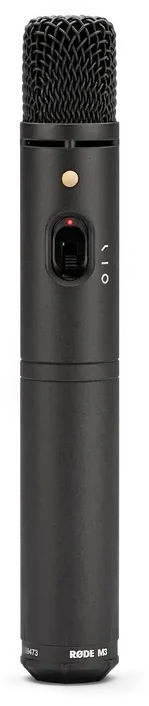
RØDE M3
End-address 1/2-inch electret condenser, cardioid; runs on a 9 V battery or phantom power, with an 80 Hz high-pass filter and a -10/-20 dB pad
Power 9 V battery, or phantom P24 or P48.
- Type
- Condenser (electret)
- Pattern
- Cardioid
- Sensitivity
- −40 dBV/Pa
- Among 204 condensers: more output than 33%
- Among 311 mics: more output than 53%
- Self-noise
- 21 dB(A)
- Among 258 condensers: quieter than 19%
- Among 272 mics: quieter than 19%
- Max SPL
- 142 dB SPL
- Among 277 condensers: takes louder sound than 73%
- Among 343 mics: takes louder sound than 71%
- Rated range
- 40 – 20k Hz
- Released
- 2007
vs 75 end-address condensers
More output than 20% of 75 end-address condensers.
Each stripe is one end-address condenser with a published sensitivity, and each bar counts them; further right means more output. This mic is in blue.
vs 104 end-address condensers
Quieter than 15% of 104 end-address condensers.
Each stripe is one end-address condenser with a published self-noise, and each bar counts them; further right means quieter. This mic is in blue.
vs 110 end-address condensers
Takes louder sound than 77% of 110 end-address condensers.
Each stripe is one end-address condenser with a published max SPL, and each bar counts them; further right means it takes louder sound. This mic is in blue.
Instruments sources recommend it for most
Proximity effect: the bass it gains up close
From the manual, p. 4.
Titled "Frequency Response"; axis "dB re 1 V/Pa" from +20 to -30 dB, but 0 dB at 1 kHz, so relative. Distance, room and smoothing not stated. Solid red line.
Dashed: outside the rated range, or simulated (other angles and distances). Hover or tap the graphs for values.
Polar pattern
From the spec sheet, p. 2.
Titled "Polar Pattern"; 500 Hz, 1 KHz and 4 KHz; rings every 2 dB, scale "dB rel. 1V/Pa" from +5 to -25. Measuring conditions and filter setting not stated.
In practice
All specs
| From the manual | ||
|---|---|---|
| Self-noise | 21 dB(A)A-weighted per IEC 651. "21dBA SPL (A - weighted per IEC651)"; the 2023 datasheet gives "21dBA (A-weighted)". | p. 3 |
| Max SPL | 142 dB SPL1 kHz, 1% THD into 1 kohm load. "142dB (@ 1kHz, 1% THD into 1kΩ load)"; the 2023 datasheet gives "142dB SPL". Max SPL with the pad is not stated. | |
| Signal-to-noise ratio | 73 dB1 kHz, re 1 Pa. "73dB SPL (@ 1kHz, rel 1Pa)". | |
| Dynamic range | 121 dBper IEC 651 | |
| Current draw | 6.5 mAP48; 1.6 mA on battery. "1.6mA - battery, 6.5mA - 48V Phantom Power". | |
| Pad | −10 dBalso −20 dB. "A choice between 0dB, -10dB and -20dB settings can be selected"; a recessed slide switch inside the body, reached by unscrewing the lower section. | p. 10 |
| Connector | XLR-3, latchingPin 1 earth, pin 2 +, pin 3 -; the cable "clicks" into place and has a release latch. | p. 6 |
| Weight | 390 gwithout battery. "390g (no battery)"; shipping weight 1285 g. The 2023 datasheet gives 390. | p. 3 |
| Dimensions | 33 × 225 mmDiameter × length: "Length - 225mm (8 3/4”), Diameter - Ø33mm (1 5/16”)". The 2023 datasheet gives "Height: 120, Width: 33, Depthr: 33" and draws 120 mm, which does not fit its own drawing's proportions (about 7:1, as 225 × 33). | |
| Maximum output | +9.22 dBu (1% THD into 1 kΩ) | |
| Battery life | More than 200 hours (9 V PP3, alkaline recommended) | |
| Power/filter switch | Three positions: battery power off and mic mute; flat; high-pass filter | p. 9 |
| Battery indicator | LED flashes once at switch-on when the battery is good; stays on when it is low | p. 10 |
| From the spec sheet | ||
| Capsule | 1/2-inch, internally shock-mounted"Featuring an internally shock-mounted 1/2-inch condenser capsule"; "Capsule: 0.50”". | p. 1 |
| Sensitivity | −40 dBV/Pa (6.3 mV/Pa)1 kHz, ±2 dB; also −40 dBV/Pa, 1 kHz, ±3 dB (2009 manual). "-40.0dB re 1 Volt/Pascal (6.30mV @ 94 dB SPL) +/- 2 dB @ 1kHz". The 2009 manual: "-40dB ±3dB re 1V/Pa @ 1kHz (6.3mV/Pa @ 94dB SPL)". | |
| Output impedance | 200 ohm"Output Impedance: 200Ω"; the manual gives the same. | |
| Rated frequency range | 40 Hz to 20 kHz"40Hz - 20kHz (selectable high-pass filter @ 80Hz)". The manual gives the same range but also says (p. 14) "The low frequency of the M3 extends to below 20Hz". | |
| Powering | 9 V battery, or phantom P24 or P48"Power Requirements: 9V battery, P24 or P48". With phantom power a fitted battery is not used (manual p. 5). | |
| Low cut | off, 80 Hz; 80 Hz; 12 dB/octave"Switched high pass filter @ 80Hz-12dB/Oct". On the three-position switch on the body (manual p. 9: battery off / mic mute, flat, high-pass filter). | |
| Supplied accessories | RM1 mic clip; windshield; ZP1 zip pouch"1 x RM1, 1 x Windshield, 1 x ZP1". The 2009 manual lists the WSM3 windshield, RM3 stand mount and ZP1 pouch. | p. 2 |
| Active electronics | JFET impedance converter with bipolar output buffer | p. 1 |
| Build | Heavy duty metal body, black; heat-treated high-strength mesh head; low handling noise; high RF rejection | |
| Compatible accessories | Boompole Pro, DS1 | p. 2 |
| From the Recording Hacks page | ||
| Released | 2007 | |
Documents
- M3 datasheetM3_Datasheet_v02
- M3 Instruction Manual
- RØDE M3 | RecordingHacks.com
Copies kept by Mic Archive (manufacturers move and drop their documents). Each is © RØDE, unchanged, with its original address.
Recommended for
By recording guides, engineers and mic makers, for this mic or an earlier version of it.