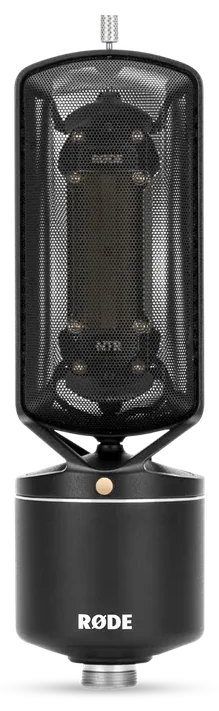
RØDE
RØDE NTR
Active ribbon microphone, figure-8, side-address; 1.8 micron ribbon, step-up transformer and preamp, needs phantom power
Approximate Some readings for this mic are uncertain; see the graphs.
Power Phantom P48.
- Type
- Ribbon
- Pattern
- Figure-8
- Sensitivity
- −30.5 dBV/Pa
- Among 28 ribbons: more output than 100%
- Among 311 mics: more output than 94%
- Self-noise
- 15 dB(A)
- Max SPL
- 130 dB SPL
- Among 29 ribbons: takes louder sound than 11%
- Among 343 mics: takes louder sound than 16%
- Rated range
- 20 – 20k Hz
- Released
- 2014
vs 24 side-address ribbons
More output than 100% of 24 side-address ribbons.
Each stripe is one side-address ribbon with a published sensitivity, and each bar counts them; further right means more output. This mic is in blue.
vs 272 mics
Quieter than 54% of 272 mics.
Each stripe is one mic with a published self-noise, and each bar counts them; further right means quieter. This mic is in blue.
vs 28 side-address ribbons
Takes louder sound than 11% of 28 side-address ribbons.
Each stripe is one side-address ribbon with a published max SPL, and each bar counts them; further right means it takes louder sound. This mic is in blue.
Instruments sources recommend it for most
Proximity effect: the bass it gains up close
From the spec sheet (Recording Hacks copy), p. 1.
Titled "Frequency Response"; axis "dB re 1 V/Pa", but the line sits about -3 dB at 1 kHz while the sensitivity is -30.5 dBV/Pa, so the scale is relative. Distance, room and smoothing not stated.
That unit is from the Multi-Angle, Multi-Distance Microphone Impulse Response Dataset (CC BY 4.0), measured at 1.25 m and set to 0 dB at 1 kHz, from 136 Hz up. Not the manufacturer's curve.
Dashed: outside the rated range, or simulated (other angles and distances). Hover or tap the graphs for values.
Polar pattern
From the spec sheet, p. 2. Approximate
Titled "Polar Pattern"; 250, 1000, 4000 and 16000 Hz; rings every 2 dB, scale "dB rel. 1V/Pa" from +5 to -25. Measuring conditions not stated.
Approximate: some frequencies are identified by reasoning, not by the legend: 16k Hz.
In practice
All specs
| From the spec sheet | ||
|---|---|---|
| Capsule | 1.8 micron ribbon, internally shock-mounted"Highly sensitive 1.8 micron ribbon element"; "Internal Shock Mounting System". | p. 1 |
| Self-noise | 15 dB(A)per IEC 651. "Equivalent Noise: 15 dBA SPL (as per IEC651)". | |
| Max SPL | 130 dB SPL"Maximum SPL: 130dB SPL"; distortion and frequency not stated. | |
| Signal-to-noise ratio | 79.3 dBA-weighted. "Signal to noise Ratio: 79.3dBA". | |
| Dynamic range | 115 dBPrinted "115dB SPL". | |
| Output impedance | 200 ohm"Output Impedance: 200Ω" (the 2014 sheet prints "200‡", the Ω sign lost). | |
| Rated frequency range | 20 Hz to 20 kHz"20Hz ~20000 Hz". | |
| Powering | phantom P48"Power Requirements: P48". Active electronics; the ribbon is not passive. | |
| Connector | XLR-3"3 Pin XLR - Balanced output between Pin 2 (+) Pin 3 (-) and Pin 1 (ground)". | |
| Weight | 1047 g | |
| Dimensions | 65 × 216 mmWidth × height from the dimension drawing: 65 mm (head) and 216 mm. | p. 2 |
| Supplied accessories | RM2 stand mount"What's in the box: 1 x NTR, 1 x RM2". A ribbon-securing travel screw is also supplied (p. 1). | |
| Active electronics | Step-up transformer (custom designed and made) and a balanced preamp stage | p. 1 |
| Maximum output | +8 dBu (1 kHz, 1% THD into 1 kΩ) | |
| Ribbon replacement | One free ribbon replacement during the warranty period | |
| Finish | Heavy-duty matte black | |
| From the quick guide | ||
| Travel screw | Secures the ribbon in transport; fit it (mic upright) whenever the mic is moved, and remove it to record | p. 1 |
| Handling | Very fragile; sensitive to plosives and air blasts, so use a pop filter for close vocals and protect the mic when not in use | |
| From the Recording Hacks page | ||
| Released | 2014 | |
| From the spec sheet (Recording Hacks copy) | ||
| Sensitivity | −30.5 dBV/Pa (30 mV/Pa)1 kHz, ±2 dB. "-30.5 dB re 1V/Pa (30mV @ 94dB SPL) ± 2dB @ 1kHz". The 2023 sheet prints the same with "Ω" in place of "±". | p. 1 |
Documents
- NTR datasheetNTR_Datasheet_FA
- NTR datasheet2014
- NTR quick start guide
- Multi-Angle, Multi-Distance Microphone Impulse Response DatasetJuan Carlos Franco Hernández, Bogdan Bacila, Tim Brookes, Enzo De Sena, University of Surrey
- RØDE NTR | RecordingHacks.com
Copies kept by Mic Archive (manufacturers move and drop their documents). Each is © RØDE, unchanged, with its original address.
Recommended for
By recording guides, engineers and mic makers, for this mic or an earlier version of it.