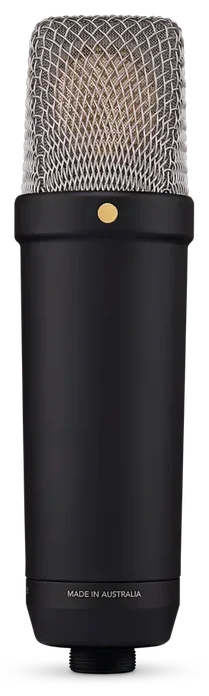
RØDE
RØDE NT1
Large-diaphragm condenser (1 inch), cardioid, 5th generation: analogue XLR and USB-C digital output (32-bit float) with on-board DSP
Power P48 phantom (XLR); 5 V USB bus power (USB-C).
- Type
- Condenser
- Pattern
- Cardioid
- Sensitivity
- −32 dBV/Pa
- Among 204 condensers: more output than 83%
- Among 311 mics: more output than 88%
- Self-noise
- 4 dB(A)
- Among 258 condensers: quieter than 98%
- Among 272 mics: quieter than 98%
- Max SPL
- 142 dB SPL
- Among 277 condensers: takes louder sound than 73%
- Among 343 mics: takes louder sound than 71%
- Rated range
- 20 – 20k Hz
- Released
- 1997
vs 75 side-address condensers
More output than 77% of 75 side-address condensers.
Each stripe is one side-address condenser with a published sensitivity, and each bar counts them; further right means more output. This mic is in blue.
vs 99 side-address condensers
Quieter than 95% of 99 side-address condensers.
Each stripe is one side-address condenser with a published self-noise, and each bar counts them; further right means quieter. This mic is in blue.
vs 107 side-address condensers
Takes louder sound than 75% of 107 side-address condensers.
Each stripe is one side-address condenser with a published max SPL, and each bar counts them; further right means it takes louder sound. This mic is in blue.
Instruments sources recommend it for most
5 of 6; all under Recommended for.
Proximity effect: the bass it gains up close
From the datasheet, p. 2.
Titled "Frequency Response"; axis "dB re 1 V/Pa", but the curve is drawn about 0 dB at 1 kHz, so relative. Distance, room and output (XLR or USB) not stated.
Dashed: outside the rated range, or simulated (other angles and distances). Hover or tap the graphs for values.
Polar pattern
From the datasheet, p. 2.
Titled "Polar Pattern"; six frequencies; rings every 2 dB, labelled -2, -10 and -20. Measuring conditions not stated.
In practice
All specs
| From the datasheet | ||
|---|---|---|
| Capsule | 1-inch (1.00") gold-sputtered capsule | p. 1 |
| Sensitivity | −32 dBV/Pa (25 mV/Pa)1 kHz, ±2 dB; XLR output. "-32 dB re 1 Volt/Pascal (25 mV @ 94 dB SPL) +/- 2 dB @ 1 kHz". | |
| Self-noise | 4 dB(A)A-weighted. "Equivalent Noise (A-Weighted): 4dBA". | |
| Max SPL | 142 dB SPLdistortion and output not stated. "Maximum SPL: 142 dB SPL". The 32-bit float USB output is said to be unclippable "up to the max SPL handling capability of the microphone". | |
| Output impedance | 100 ohmoutput impedance (XLR) | |
| Rated frequency range | 20 Hz to 20 kHz | |
| Powering | P48 phantom (XLR); 5 V USB bus power (USB-C)Analogue: "Via XLR: P48"; digital (p. 2): "Via USB: 5V". | |
| Connector | XLR-3 (analogue) and USB-C (digital)XLR on p. 1, USB-C on p. 2. | |
| Weight | 308 g"Weight (grams): 308". | p. 2 |
| Dimensions | 52 × 52 × 189 mmLength 52, width 52, height 189, as printed: a 52 mm diameter body, 189 mm tall. | |
| Supplied accessories | SM6 shock mount and pop filter; SC29 3 m USB-C cable; 6 m XLR cable; dust cover | |
| Acoustic principle | Pressure gradient | p. 1 |
| Active electronics | JFET impedance converter with bipolar output buffer | |
| Address type | Side | |
| Digital processing | APHEX: compressor, noise gate, high-pass filter, Aural Exciter and Big Bottom (only at 48 kHz) | |
| Minimum OS | Windows 10, macOS 10.15 | p. 2 |
| Software | RØDE Central, RØDE Connect, RØDE UNIFY | |
| Finishes | Black, silver | p. 1 |
| Made in | Designed and made in RØDE's facilities in Sydney, Australia | |
| Warranty | 10 years | |
| From the Recording Hacks page | ||
| Released | 1997 | |
| From the user guide | ||
| USB processing modes | APHEX processing needs 48 kHz and 24-bit; 32-bit float on Windows needs RØDE's ASIO driver | p. 1 |
| From the quick guide | ||
| Mounting | Screws into the SM6 shock mount; the gold dot faces the source | p. 2 |
Documents
- NT1 5th Generation datasheet
- NT1 5th Generation Quick Start Guide0927-0836-03-01
- NT1 5th Generation User Guideweb page
- NT1 datasheetV05; the 4th-generation, XLR-only NT1
- RØDE NT1 | RecordingHacks.com
Copies kept by Mic Archive (manufacturers move and drop their documents). Each is © RØDE, unchanged, with its original address.
Recommended for
By recording guides, engineers and mic makers, for this mic or an earlier version of it.