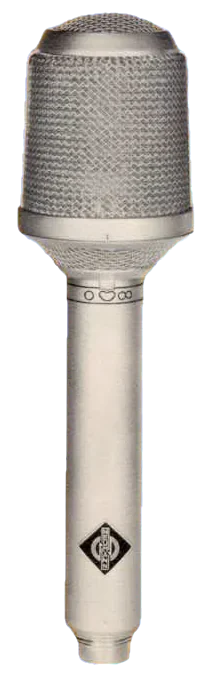
Neumann
Neumann KM 86
Small condenser, two back-to-back cardioid capsules: omni, cardioid or figure-8; fet 80 series, P48; made about 1968 to 1986, discontinued
Power Phantom, 48 V ± 4 V (P 48, DIN 45 596).
- Type
- Condenser
- Pattern
- Switchable, 3
- Sensitivity
- −40.4 dBV/Pa
- Among 204 condensers: more output than 33%
- Among 311 mics: more output than 53%
- Self-noise
- 19 dB(A)
- Among 258 condensers: quieter than 29%
- Among 272 mics: quieter than 28%
- Max SPL
- 121 dB SPL
- Among 277 condensers: takes louder sound than 7%
- Among 343 mics: takes louder sound than 6%
- Rated range
- 40 – 20k Hz
- Released
- 1968
vs 75 side-address condensers
More output than 16% of 75 side-address condensers.
Each stripe is one side-address condenser with a published sensitivity, and each bar counts them; further right means more output. This mic is in blue.
vs 99 side-address condensers
Quieter than 10% of 99 side-address condensers.
Each stripe is one side-address condenser with a published self-noise, and each bar counts them; further right means quieter. This mic is in blue.
vs 107 side-address condensers
Takes louder sound than 11% of 107 side-address condensers.
Each stripe is one side-address condenser with a published max SPL, and each bar counts them; further right means it takes louder sound. This mic is in blue.
Instruments sources recommend it for most
Proximity effect: the bass it gains up close
From the manual, p. 10.
KM 86 i graph in "11. Frequency Responses and Polar Patterns"; relative dB, the curve marked at 1 kHz. Distance and room not stated. Dashed tolerance lines either side (not stored).
Dashed: outside the rated range, or simulated (other angles and distances). Hover or tap the graphs for values.
In practice
All specs
| From the manual | ||
|---|---|---|
| Capsule | Two small single-diaphragm cardioid capsules, back to back"Two back-to-back, individual capsules permit the three directional characteristics: omni, cardioid and figure-8 to be electrically selected by means of a switch located below the capsule head." Recording Hacks names them as KK 84 capsules. | p. 2 |
| Sensitivity | −40.4 dBV/Pa (9.5 mV/Pa)1 kHz. Stated as 9.5 mV/Pa; converted: 20·log10(0.0095) = -40.4. | p. 8 |
| Self-noise | 19 dB(A)IEC 179. "Equivalent loudness level due to inherent noise, IEC 179: 19 dB-A". | |
| Self-noiseCCIR 468 | 30 dBCCIR 468-1 (1976) | |
| Max SPL | 121 dB SPLless than 0.5% THD at 1 kHz; also 131 dB SPL, with pre-attenuation; also 122 dB SPL, brochure: "≧ 250 µb ≙ 122 dB" for 0.5% THD. "Max. SPL for less than 0.5 % THD at 1 kHz: 121 dB; with pre-attenuation 131 dB": "THD of the microphone amplifier when an input level equivalent to the capsule output at the specified SPL is applied". | |
| Signal-to-noise ratio | 68 dBDIN 45 590, re 1 Pa. "S/N ratio according to DIN 45 590 (ref. level 1 Pa) 68 dB". | |
| Output impedance | 200 ohmsource impedance; switchable to 50 ohm; also 50 ohm, switched. "Source impedance switchable to 200 / 50 ohms". Recording Hacks: mics set to 50 ohm at the factory have a red dot by the serial number. | |
| Rated load impedance | 1000 ohmminimum; 250 ohm with the 50 ohm setting; also 250 ohm, with 50 ohm source impedance. "Minimum load impedance 1000/250 ohms". | |
| Rated frequency range | 40 Hz to 20 kHzalso [40, 16000], brochure (KM 86). "Frequency range 40 ... 20 000 Hz" (KM 86 i). | |
| Powering | phantom, 48 V ± 4 V (P 48, DIN 45 596)The brochure: "48 +6/−8 VDC". | |
| Current draw | 0.4 mAThe brochure: "appr. 0,4 mA". | |
| Pad | −10 dB"On the back of the amplifier housing of all microphones there is a 10 dB overload switch. This switch is recessed". Not shown in the graphs. | p. 3 |
| Connector | XLR-3 (KM 86 i); 3-pin Binder/Tuchel (KM 86)The table gives dimensions for a "Version with Switchcraft connectors" and a "Version with Binder connectors". Recording Hacks: KM 86 with Binder/Tuchel, KM 86 i with XLR. | p. 8 |
| Weight | 200 gThe brochure also says 200 g. | |
| Dimensions | 21 × 47 × 185 mmalso [21, 47, 175], version with Binder connector. Printed "21/47" diameter and 185 mm length for the Switchcraft (XLR) version, 175 mm for the Binder version: body diameter, head diameter, length. The brochure: "21+46 mm Ø, 175 mm long". | |
| Equivalent loudnessDIN 45 405 | 26 dB (1967 method); brochure: about 25 dB (cardioid), "dB re 2·10⁻⁴ µb" | |
| Battery operation | About 15 hours from the BS 945 i battery supply; the brochure: about 200 hours (with the BS 45 of that time) | |
| Low frequencies | Low frequencies reproduced equally well in all three patterns, even far from the source; high-frequency response nearly linear in both the diffuse and the free field | p. 2 |
| Address | From the side, the front being the side with the Neumann insignia | |
| From the Recording Hacks page | ||
| Released | 1968"The mic was released in 1968."; "discontinued in 1986"; "its 18-year production run". | |
| Production | About 1968 to 1986 | |
| Versions | KM 86 (Binder/Tuchel, nickel, 175 mm), KM 86 i (XLR, nickel, 185 mm), KM 86 mt and KM 86 i mt (dark matte) | |
| From the catalog | ||
| Capsule capacitance | 2 x about 34 pF | p. 4 |
| From the product page | ||
| History | Like the KM 76, a transistor successor to the KM 66 tube microphone; the KM 86 was made for P48 phantom power | |
Documents
- Operating Instructions for Neumann Condenser Microphones of the fet 80 series, KM 83 i, KM 84 i, KM 85 i, KM 86 i, KM 88 i, KMS 84 iEnglish, April 1984
- Neumann transistor condenser microphones: KM 73, KM 74, KM 76, U 77, KM 83, KM 84, KM 86, U 87brochure, English, undated
- KM 86neumann.com, historical products
- Neumann KM 86recordinghacks.com
Copies kept by Mic Archive (manufacturers move and drop their documents). Each is © Neumann, unchanged, with its original address.
Recommended for
By recording guides, engineers and mic makers, for this mic or an earlier version of it.
Other mics
More from Neumann
- Neumann KM 184
- Neumann U 87 (U 87 i)
- Neumann KM 84
- Neumann TLM 103
- Neumann U 47
- Neumann U 67
- Neumann U 47 fet
- Neumann TLM 170 R