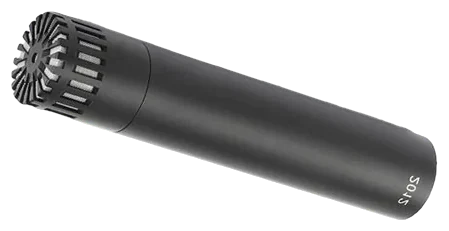
DPA Microphones
DPA 2012
Compact cardioid pencil condenser (17 mm pre-polarised capsule, 94 mm body)
Approximate Some readings for this mic are uncertain; see the graphs.
Power P48 (phantom power).
- Type
- Condenser (electret)
- Pattern
- Cardioid
- Sensitivity
- −42 dBV/Pa
- Among 204 condensers: more output than 25%
- Among 311 mics: more output than 47%
- Self-noise
- 20 dB(A)
- Among 258 condensers: quieter than 23%
- Among 272 mics: quieter than 23%
- Max SPL
- 148 dB SPL
- Among 277 condensers: takes louder sound than 88%
- Among 343 mics: takes louder sound than 87%
- Rated range
- 20 – 20k Hz
vs 75 end-address condensers
More output than 12% of 75 end-address condensers.
Each stripe is one end-address condenser with a published sensitivity, and each bar counts them; further right means more output. This mic is in blue.
vs 104 end-address condensers
Quieter than 19% of 104 end-address condensers.
Each stripe is one end-address condenser with a published self-noise, and each bar counts them; further right means quieter. This mic is in blue.
vs 110 end-address condensers
Takes louder sound than 95% of 110 end-address condensers.
Each stripe is one end-address condenser with a published max SPL, and each bar counts them; further right means it takes louder sound. This mic is in blue.
Instruments sources recommend it for most
Proximity effect: the bass it gains up close
From the response image.
Captioned (on the product page) "Typical on-axis response of a 2012 ... measured at 30 cm (11.8 in)". Drawn solid from 40 Hz to 20 kHz, dotted outside. Room not stated.
Dashed: outside the rated range, or simulated (other angles and distances). Hover or tap the graphs for values.
Polar pattern
From the polar image. Approximate
Captioned "Typical directional characteristics of a 2012"; 5 dB per ring, centre -25 dB. Measuring conditions not stated.
Approximate: reading error up to about 1 dB; some frequencies are identified by reasoning, not by the legend: 2k Hz, 4k Hz.
In practice
All specs
| From the product page | ||
|---|---|---|
| Capsule | 17 mm pre-polarised condenser, pressure gradientCapsule diameter 17 mm (0.67 in); "Principle of operation: Pressure gradient". | |
| Self-noise | 20 dB(A)typ. (max. 22 dB(A)) | |
| Max SPL | 148 dB SPLTHD < 1% (RMS not said); also 151 dB SPL, THD < 1%, peak; also 156 dB SPL, THD 10%, peak; also 153 dB SPL, THD 10% (CCI copy). "Distortion, THD < 1%: 148 dB SPL, 151 dB SPL peak"; "Max. SPL, THD 10%: 156 dB SPL peak". The CCI copy (p. 2) gives the 10% figure as "153 dB SPL (156 dB SPL peak)". | |
| Dynamic range | 131 dBtyp. | |
| Output impedance | 60 ohmrated | |
| Rated frequency range | 20 Hz to 20 kHzEffective range ±2 dB at 30 cm: 40 Hz to 20 kHz. | |
| Powering | P48 (phantom power)"Power supply (for full performance)". | |
| Current draw | 0.7 mA | |
| Connector | XLR-3M (pin 1 shield, pin 2 signal + phase, pin 3 - phase) | |
| Weight | 83 g"83 g (2,9 oz)". | |
| Dimensions | 19 × 94 mmDiameter × length: microphone diameter 19 mm (0.75 in), length 94 mm (3.7 in). | |
| Cable drive capability | 100 m (328 ft) | |
| Output balance principle | Impedance balancing with Active Drive | |
| CMRR | > 60 dB | |
| Maximum output voltage, RMS | 8.7 V (21 dBu) | |
| Polarity | +V at pin 2 for positive sound pressure | |
| Temperature range | -40 °C to 45 °C | |
| Relative humidity | Up to 90% | |
| From the spec sheet | ||
| Sensitivity | −42 dBV/Pa (8 mV/Pa)nominal, ±2 dB at 1 kHz. "8 mV/Pa; -42 dB re. 1 V/Pa" (the product page gives only "8 mV/Pa"). | p. 2 |
| Rated load impedance | 2000 ohmminimum. "Minimum load impedance 2 kΩ". | p. 3 |
| Finish | matte black | |
| Sensitivity selection toleranceat 1 kHz | ±1.5 dB | p. 4 |
| Switchable attenuator, filters etc. | none ("-") | p. 2 |
Documents
- 2012 Compact Cardioid Microphoneproduct page specifications
- DPA Document Portal - Pencil Microphones2012 Compact Cardioid, Specifications - 2012
- Typical on-axis response of a 2012 Compact Cardioid Microphone measured at 30 cmgraph image
- Typical directional characteristics of a 2012 Compact Cardioid Microphonegraph image


Copies kept by Mic Archive (manufacturers move and drop their documents). Each is © DPA Microphones, unchanged, with its original address.
Recommended for
By recording guides, engineers and mic makers, for this mic or an earlier version of it.