LEWITT
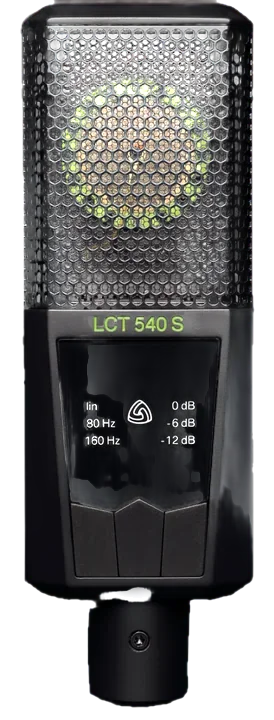
LEWITT LCT 540 S
Large-diaphragm condenser (1 inch, externally polarised), cardioid only, with push-button low cut and pad
Power Phantom 48 V ± 4 V (IEC 61938).
- Type
- Condenser
- Pattern
- Cardioid
- Sensitivity
- −28 dBV/Pa
- Among 204 condensers: more output than 97%
- Among 311 mics: more output than 98%
- Self-noise
- 4 dB(A)
- Among 258 condensers: quieter than 98%
- Among 272 mics: quieter than 98%
- Max SPL
- 136 dB SPL
- Among 277 condensers: takes louder sound than 45%
- Among 343 mics: takes louder sound than 42%
- Rated range
- 20 – 20k Hz
vs 75 side-address condensers
More output than 99% of 75 side-address condensers.
Each stripe is one side-address condenser with a published sensitivity, and each bar counts them; further right means more output. This mic is in blue.
vs 99 side-address condensers
Quieter than 95% of 99 side-address condensers.
Each stripe is one side-address condenser with a published self-noise, and each bar counts them; further right means quieter. This mic is in blue.
vs 107 side-address condensers
Takes louder sound than 43% of 107 side-address condensers.
Each stripe is one side-address condenser with a published max SPL, and each bar counts them; further right means it takes louder sound. This mic is in blue.
Proximity effect: the bass it gains up close
From the manual, p. 11.
"Figure 9.1 - Frequency response of the LCT 540 S"; relative dB, with the three low-cut settings. Distance and smoothing not stated; the specifications say the microphones are measured according to IEC 60268-4.
Dashed: outside the rated range, or simulated (other angles and distances). Hover or tap the graphs for values.
Polar pattern
From the manual, p. 11.
"Figure 9.2 - Polar patterns of the LCT 540 S"; eight frequencies, 125 Hz to 16 kHz; rings labelled "0" and "-10", 5 dB apart. Low-cut setting not stated.
In practice
All specs
| From the manual | ||
|---|---|---|
| Capsule | 1 inch (25.4 mm), 3 micron gold-sputtered Mylar diaphragm"Transducer Ø 25. 4 mm, 1 in"; "Diaphragm 3 micron gold sputtered Mylar". | p. 12 |
| Sensitivity | −28 dBV/Pa (41 mV/Pa)"41 mV/Pa, -28 dBV/Pa" (20·log10(0.041) = -27.7). | |
| Self-noise | 4 dB(A)per IEC 60268-1. "Equivalent noise level 4 dB (A)"; the product page calls it "Self-noise". | |
| Max SPL | 136 dB SPL0.5% THD, 0 dB pre-attenuation. "Max. SPL for 0.5 % THD 136 dBSPL, 0 dB pre-attenuation". No figure is given with the pad. | |
| Signal-to-noise ratio | 90 dBA-weighted. "Signal / noise ratio 90 dB (A)". | |
| Dynamic range | 132 dBA-weighted. "Dynamic range 132 dB (A)". | |
| Output impedance | 68 ohm"Internal impedance 68 Ω". | |
| Powering | phantom 48 V ± 4 V (IEC 61938)"Supply voltage 48 V +/- 4 V". | |
| Current draw | 3.6 mA"Current consumption 3. 6 mA". | |
| Connector | XLR-3 male, gold-plated"Gold plated 3-pin XLR". | |
| Weight | 371 gnet. "371 g, 13. 1 oz". | |
| Dimensions | 158 × 52 × 36 mm"158 x 52 x 36 mm"; presumably height × width × depth. | |
| Supplied accessories | LCT 40 SH shock mount (5/8" thread, 3/8" adapter); LCT 50 PSx magnetic pop filter; LCT 40 Wx windscreen; DTP 40 Lb leatherette transport bag"Box contents". Page 12 also describes a "military-grade protective case". | p. 3 |
| Acoustic principle | Pressure gradient transducer | p. 12 |
| Enclosure | Zinc die cast | |
| Display and buttons | Illuminated status, low-cut and pad indicators; key-lock, Clipping History and Automatic Attenuation (pad set automatically when clipping occurs, for test runs) | p. 4 |
| From the product page | ||
| Rated frequency range | 20 Hz to 20 kHz"Frequency range 20 ... 20,000 Hz"; not in the manual's table. Tolerance not stated. | p. 1 |
| Low cut | off, 80 Hz, 160 Hz; 6 dB/octave; high-pass"Low-cut filter: linear, 80 Hz (6 dB/oct), 160 Hz (6 dB/oct)"; chosen with the left push-button; the manual (p. 4) labels the positions "lin", "80 Hz", "160 Hz". | |
| Pad | −6 dBalso −12 dB. "Attenuation 0 dB, -6 dB, -12 dB"; chosen with the right push-button ("pre-attenuation", manual p. 4). | |
| Standards | Measured to IEC 60268-4; phantom power to IEC 61938; noise to IEC 60268-1 | |
| From the quick guide | ||
| Perfect Match | Polarisation voltage adjusted on every unit for the same sensitivity at 1 kHz, so any two can be paired | p. 1 |
| Front | The illuminated user interface faces the source | |
Documents
- LCT 540 S User Manual
- LCT 540 S Quickstart Guide
- LCT 540 Sproduct page
Copies kept by Mic Archive (manufacturers move and drop their documents), unchanged, with their original addresses. Each is © its publisher.