Shure
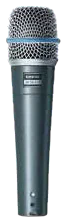
Shure Beta 57A
Dynamic (moving coil), supercardioid, instrument mic with neodymium magnet
Power None: a dynamic mic needs no power. Low output: it needs a lot of preamp gain.
- Type
- Dynamic
- Pattern
- Supercardioid
- Sensitivity
- −51 dBV/Pa
- Among 78 dynamics: more output than 86%
- Among 311 mics: more output than 30%
- Rated range
- 50 – 16k Hz
- Released
- 1989
vs 25 handheld dynamics
More output than 79% of 25 handheld dynamics.
Each stripe is one handheld dynamic with a published sensitivity, and each bar counts them; further right means more output. This mic is in blue.
Instruments sources recommend it for most
5 of 11; all under Recommended for.
Proximity effect: the bass it gains up close
From the spec sheet, p. 1.
"Frequency Response"; relative dB. The 2003 user guide: "on-axis response at a distance of 2 feet from a uniform sound source". Room and smoothing not stated.
Dashed: outside the rated range, or simulated (other angles and distances). Hover or tap the graphs for values.
Polar pattern
From the spec sheet, p. 1.
"Polar Pattern"; two plots (250 Hz to 1 kHz, 2500 Hz to 10 kHz), 0° at the bottom, 5 dB per ring, the outer ring 0 dB. Measuring conditions not stated.
In practice
All specs
| From the user guide | ||
|---|---|---|
| Supplied accessories | A25D microphone clip; 95A2050 5/8" to 3/8" thread adapter; 95A2314 zippered carrying bag"Furnished Accessories". The 2003 guide lists the storage bag as 26A21. | p. 7 |
| Housing | Silver blue enamel-painted die-cast metal with hardened, matte-finished steel mesh grille | p. 5 |
| Greatest rejection | At 120° toward the rear; place monitors there, not directly behind | p. 4 |
| Proximity effect | 6 to 10 dB bass boost below 100 Hz at about 6 mm (1/4 in.); the bass gradually rolls off to prevent explosive low frequency sound close up | p. 5 |
| Replacement parts | Cartridge R174 (also for BETA56, BETA56A); grille RK320; plug (connector) assembly 90J1984 | p. 7 |
| Optional accessories | A57AWS locking foam windscreen; A55HM Shock Stopper isolation mount; C25E 7.5 m XLR cable | |
| PlacementShure | Guitar and bass amps: 2.5 cm from the speaker on the cone axis for sharp attack and emphasised bass, 15-30 cm for a full, balanced sound; snare and toms 2.5-7.5 cm above the head | p. 4 |
| From the spec sheet | ||
| Sensitivity | −51 dBV/Pa (2.8 mV/Pa)1 kHz, open circuit voltage. "−51 dBV/Pa (2.8 mV)"; the same in both user guides. | p. 1 |
| Rated frequency range | 50 Hz to 16 kHz | |
| Connector | XLR-3 male"Three-pin professional audio (XLR), male". | |
| Weight | 275 gnet. "Net: 0.275 kg (0.6 lbs)". | |
| Shock mount | Advanced pneumatic shock mount system | |
| Magnet | Neodymium | |
| From the user guide (Recording Hacks copy) | ||
| Output impedance | 150 ohmrated; 290 ohm actual. "Rated impedance is 150 Ω (290 Ω actual)". The 2015 sheet gives "150 Ω"; the 2023 guide gives "290 Ω" as the output impedance. | p. 2 |
| Stand adapter | Slip-in, adjustable through 180°, standard 5/8"-27 thread | |
| Phasing | Positive pressure on diaphragm produces positive voltage on pin 2 with respect to pin 3 | |
| From the Recording Hacks page | ||
| Released | 1989 | |
Documents
- Beta 57A Supercardioid Dynamic Instrument Microphone, Product Specifications
- BETA57A Instrument Microphone, user guideversion 3.0, 2023-C
- Model BETA 57A Supercardioid Dynamic Performance Microphone, user guide
- Shure Beta 57A | RecordingHacks.com
Copies kept by Mic Archive (manufacturers move and drop their documents). Each is © Shure, unchanged, with its original address.
Recommended for
By recording guides, engineers and mic makers, for this mic or an earlier version of it.