Shure
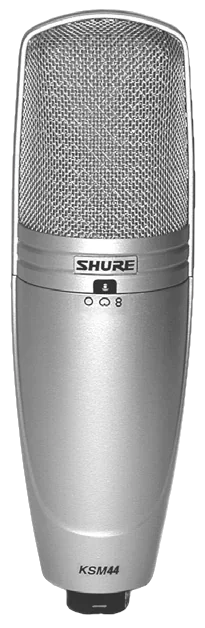
Shure KSM44
Large dual-diaphragm condenser, multi-pattern (cardioid, omni, figure-8), transformerless, with pad and low-frequency filter
Approximate Some readings for this mic are uncertain; see the graphs.
Power Phantom 48 V DC ± 4 V (IEC-268-15/DIN 45 596).
- Type
- Condenser
- Pattern
- Switchable, 3
- Sensitivity
- −31 dBV/Pa
- Among 204 condensers: more output than 89%
- Among 311 mics: more output than 92%
- Self-noise
- 7 dB(A)
- Among 258 condensers: quieter than 92%
- Among 272 mics: quieter than 93%
- Max SPL
- 127 dB SPL
- Among 277 condensers: takes louder sound than 13%
- Among 343 mics: takes louder sound than 12%
- Rated range
- 20 – 20k Hz
vs 75 side-address condensers
More output than 89% of 75 side-address condensers.
Each stripe is one side-address condenser with a published sensitivity, and each bar counts them; further right means more output. This mic is in blue.
vs 99 side-address condensers
Quieter than 83% of 99 side-address condensers.
Each stripe is one side-address condenser with a published self-noise, and each bar counts them; further right means quieter. This mic is in blue.
vs 107 side-address condensers
Takes louder sound than 19% of 107 side-address condensers.
Each stripe is one side-address condenser with a published max SPL, and each bar counts them; further right means it takes louder sound. This mic is in blue.
Instruments sources recommend it for most
5 of 12; all under Recommended for.
Proximity effect: the bass it gains up close
From the user guide (Recording Hacks copy), p. 8.
Figure 4, "Typical cardioid frequency response"; relative dB. Room and smoothing not stated.
Dashed: outside the rated range, or simulated (other angles and distances). Hover or tap the graphs for values.
Polar pattern
From the user guide (Recording Hacks copy), p. 8. Approximate
Figure 5, "Typical cardioid polar pattern"; two plots (125 Hz to 1 kHz, 2500 Hz to 15 kHz), 0° at the bottom, 5 dB per ring from +5 dB (outer) to -20 dB. Measuring conditions not stated.
Approximate: reading error up to about 1 dB.
In practice
All specs
| From the user guide (Recording Hacks copy) | ||
|---|---|---|
| Capsule | dual 1-inch, 2.5 µm, 24-karat gold-layered Mylar diaphragms"Dual 1 inch, externally biased, ultra-thin, 2.5 µm, 24 Karat gold-layered, low mass, Mylar® diaphragms". | p. 3 |
| Sensitivity | −31 dBV/Pacardioid; typical, 1 kHz; also −37 dBV/Pa, omni; also −36 dBV/Pa, figure-8 | p. 7 |
| Self-noise | 7 dB(A)cardioid; typical, equivalent SPL, A-weighted, IEC 651; also 10 dB(A), omni; also 10 dB(A), figure-8 | |
| Max SPL | 127 dB SPLcardioid; 1 kHz, 1000 ohm load; also 132 dB SPL, cardioid, 2500 ohm load; also 144 dB SPL, cardioid, 1000 ohm load, pad on; also 149 dB SPL, cardioid, 2500 ohm load, pad on; also 132 dB SPL, omni, 1000 ohm; also 138 dB SPL, omni, 2500 ohm; also 131 dB SPL, figure-8, 1000 ohm; also 137 dB SPL, figure-8, 2500 ohm; also 156 dB SPL, pad on, 5500 ohm or greater load. Table: "132 (149) dB" (2500 ohm) and "127 (144) dB" (1000 ohm) for cardioid, the bracketed figure with the attenuator on. With the pad: omni 145 / 151 dB, figure-8 144 / 150 dB (1000 / 2500 ohm). The 156 dB figure is from p. 6: "With the -15 dB pad engaged, the KSM44 can handle up to 156 dB SPL and output +15 dBV into a 5500 ohm or greater load." | |
| Signal-to-noise ratio | 87 dBcardioid; 94 dB SPL minus self-noise; also 84 dB, omni; also 84 dB, figure-8. "S/N ratio is difference between 94 dB SPL and equivalent SPL of self-noise A-weighted". | |
| Dynamic range | 120 dBcardioid; 1000 ohm load; also 125 dB, cardioid, 2500 ohm; also 122 dB, omni, 1000 ohm; also 128 dB, omni, 2500 ohm; also 121 dB, figure-8, 1000 ohm; also 127 dB, figure-8, 2500 ohm | |
| Output impedance | 150 ohmactual. "150 Ω (actual)". | |
| Rated load impedance | 1000 ohmrecommended minimum. "A load impedance of at least 1000 Ω is recommended." | p. 6 |
| Rated frequency range | 20 Hz to 20 kHz | p. 7 |
| Powering | phantom 48 V DC ± 4 V (IEC-268-15/DIN 45 596)P. 4: "it will operate with slightly decreased headroom and sensitivity with supplies as low as 11 Vdc". | |
| Current draw | 5.4 mAtypical, at 48 V | |
| Low cut | flat, 6 dB/oct below 115 Hz, 18 dB/oct below 80 Hz"Flat; -6 dB/octave below 115 Hz; -18 dB/octave below 80 Hz". Graphed on their own in Figure 2 (p. 5). | |
| Pad | −15 dB"0 or 15 dB attenuation". | |
| Weight | 490.5 g | |
| Dimensions | 55.9 × 187 mm"55.9 mm (2.20 in.) maximum body diameter, 187 mm (7.37 in.) long" (diameter × length). | |
| Supplied accessories | A44SM ShureLock elastic shock mount (champagne); A44M ShureLock swivel adapter (champagne); A44SC aluminium carrying case; A44VB velveteen pouchFurnished accessories. | p. 10 |
| Output clipping level | 7 dBV into 2500 ohm, 1 dBV into 1000 ohm (all three patterns; 20 Hz-20 kHz, THD < 1%) | p. 7 |
| Common mode rejection | ≥50 dB, 20 Hz to 20 kHz | |
| Polarity | Positive pressure on the front diaphragm gives positive voltage on pin 2 relative to pin 3 | |
| Electronics | Class A, discrete, transformerless preamplifier; subsonic filter below 17 Hz; three-stage pop grille; internal shock mount | p. 3 |
| Optional accessories | A32WS windscreen, A32ZB padded zippered bag, PS-6 Popper Stopper pop filter | p. 10 |
| Replacement parts | Shock mount elastic cord (champagne) 95B2125 | |
Documents
- KSM44 Multiple Polar Pattern Condenser Microphone, User Guide27E3122 Rev. 1
Copies kept by Mic Archive (manufacturers move and drop their documents), unchanged, with their original addresses. Each is © its publisher.
Recommended for
By recording guides, engineers and mic makers, for this mic or an earlier version of it.