Shure
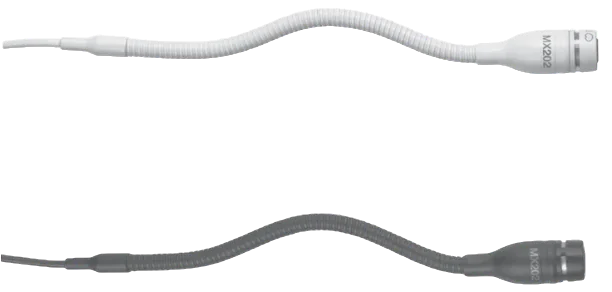
Shure MX202
Miniature electret condenser overhead mic on a 4-inch gooseneck, for choirs; interchangeable cartridges (cardioid, supercardioid, mini-shotgun; omni in the 2013 sheet), black or white
Approximate Some readings for this mic are uncertain; see the graphs.
Power Phantom 11-52 V DC.
- Type
- Condenser (electret)
- Pattern
- Switchable, 4
- Sensitivity
- −35 dBV/Pa
- Among 204 condensers: more output than 64%
- Among 311 mics: more output than 75%
- Self-noise
- 28 dB(A)
- Among 258 condensers: quieter than 5%
- Among 272 mics: quieter than 5%
- Max SPL
- 124.2 dB SPL
- Among 277 condensers: takes louder sound than 9%
- Among 343 mics: takes louder sound than 8%
- Rated range
- 50 – 17k Hz
vs 75 end-address condensers
More output than 64% of 75 end-address condensers.
Each stripe is one end-address condenser with a published sensitivity, and each bar counts them; further right means more output. This mic is in blue.
vs 104 end-address condensers
Quieter than 2% of 104 end-address condensers.
Each stripe is one end-address condenser with a published self-noise, and each bar counts them; further right means quieter. This mic is in blue.
vs 110 end-address condensers
Takes louder sound than 6% of 110 end-address condensers.
Each stripe is one end-address condenser with a published max SPL, and each bar counts them; further right means it takes louder sound. This mic is in blue.
Instruments sources recommend it for most
1 of 3; all under Recommended for.
Proximity effect: the bass it gains up close
From the spec sheet, p. 2.
Figure 1, "Typical Frequency Response", cardioid; relative dB. Distance, room and smoothing not stated.
Dashed: outside the rated range, or simulated (other angles and distances). Hover or tap the graphs for values.
Polar pattern
From the spec sheet, p. 2.
Figure 2, "Typical Polar Patterns", cardioid: two plots (250 Hz to 1 kHz, 2500 Hz to 10 kHz), 0° at the bottom, 5 dB per ring.
In practice
All specs
| From the spec sheet | ||
|---|---|---|
| Sensitivity | −35 dBV/Pa (17.8 mV/Pa)cardioid; 1 kHz, open circuit; also −33.5 dBV/Pa, supercardioid; also −27.5 dBV/Pa, omni; also −33 dBV/Pa, mini-shotgun (2026 user guide, page 9). "Cardioid: –35.0 dBV/Pa (17.8 mV), Supercardioid: –33.5 dBV/Pa (21.1 mV), Omnidirectional: –27.5 dBV/Pa (42.2 mV)". The 2026 guide rounds to -35 (18 mV) and -34 dBV/Pa (21 mV), and gives -33 dBV/Pa (22 mV) for the mini-shotgun. | p. 1 |
| Self-noise | 28 dB(A)cardioid; equivalent output noise, A-weighted; also 26.5 dB(A), supercardioid; also 20.5 dB(A), omni; also 26 dB(A), mini-shotgun (2026 user guide, page 9). The 2026 guide ("Self Noise"): 28, 27 and 26 dB SPL for cardioid, supercardioid and mini-shotgun. | |
| Max SPL | 124.2 dB SPLcardioid; 1 kHz, 1% THD, 1 kohm load; also 122.7 dB SPL, supercardioid; also 116.7 dB SPL, omni; also 121 dB SPL, mini-shotgun (2026 user guide, page 9). Printed "Cardioid: 124.2" without unit. The 2026 guide: 124, 123 and 121 dB. | |
| Signal-to-noise ratio | 66 dBcardioid; ref. 94 dB SPL; also 67.5 dB, supercardioid; also 73.5 dB, omni; also 68 dB, mini-shotgun (2026 user guide, page 9). Printed "Cardioid: 66.0" without unit. The 2026 guide: 66, 68 and 68 dB. | |
| Dynamic range | 96.2 dB1 kohm load. One figure for all cartridges; it equals the cardioid max SPL minus its self-noise. The 2026 guide: 96 dB at 1 kHz. | |
| Output impedance | 150 ohmEIA rated; 180 ohm actual. The 2026 guide gives 180 ohm. | |
| Rated frequency range | 50 Hz to 17 kHz | |
| Powering | phantom 11-52 V DC | |
| Current draw | 2 mA | |
| Connector | XLR-3 male on the in-line preamplifier (RK100PK); TA4F between the mic cable and the preampWiring diagram. The plate-mounted preamp versions (MX202BP, MX202WP) have terminal blocks instead (guide, page 7). | p. 2 |
| Dimensions | 11.7 × 144.5 mmFigure 3: head diameter × length of head and gooseneck. In-line preamp 19.0 × 101.6 mm; the text calls the gooseneck "101 mm (4 in.)". | |
| Finish | black or white"White or black finish that blends unobtrusively with most surroundings". | p. 1 |
| Common mode rejection | 45.0 dB minimum | |
| Preamplifier output clipping level | –6.0 dBV (0.5 V), 1% THD | |
| Gooseneck | 101 mm (4 in.), attached | |
| Cable | 9.1 m (30 ft) | p. 2 |
| In-line preamplifier | 19.0 mm diameter, 101.6 mm long; RK100PK (black or white) | |
| Operating conditions | –18 to 57 °C, 0 to 95% relative humidity | p. 1 |
| Replacement parts | Cartridges R183B/W (omni), R184B/W (supercardioid), R185B/W (cardioid); in-line preamp RK100PK/B or /W; stand adaptor 65B1752 | |
| From the user guide | ||
| Capsule | interchangeable miniature cartridges: R185 cardioid, R184 supercardioid, R183 omni, R189 mini-shotgunDrawing of the four cartridges with their part numbers; the 2013 sheet lists R183, R184 and R185 (page 1). | p. 4 |
| Supplied accessories | RK183WS snap-fit foam windscreens, black (4); 95B2064 snap-fit windscreen, white; 65B1752 stand adaptor (MX202B and MX202W); RK202PK plate-mounted preamplifier kit (MX202BP and MX202WP)"Furnished Accessories". | p. 10 |
| Mini-shotgun version | Suffix /MS (2026 guide) | p. 3 |
| Pickup angle | cardioid 130°, supercardioid 115°, mini-shotgun 100°, omni 360° | p. 4 |
| Output configuration | Active balanced | p. 9 |
| RF immunity | Use with the RK100PK or RK202PK preamp to optimise RF immunity | p. 4 |
| Windscreen | Snap-fit foam, "30 dB of pop protection" | |
| PlacementShure | Choir: hang the mic 0.6-0.9 m in front of the first row and 0.6-0.9 m above the heads of the last row, aimed at the back row; bend the gooseneck into a "lazy S" | |
| From the catalog | ||
| Models | MX202B and MX202W (black or white, in-line preamp and stand adapter); MX202BP and MX202WP (plate-mounted preamp); suffix /C cardioid, /S supercardioid, /N no cartridge | p. 4 |
Documents
- Model MX200 Series Microphone Specification SheetTL1050 Rev. 2
- MX200 Series Overhead Microphones, user guideversion 6.2, 2026-E
- Microflex brochureEnglish
Copies kept by Mic Archive (manufacturers move and drop their documents). Each is © Shure, unchanged, with its original address.
Recommended for
By recording guides, engineers and mic makers, for this mic or an earlier version of it.