AKG
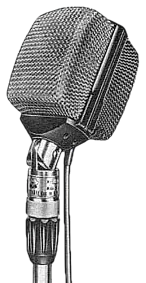
AKG D 12
Dynamic (moving coil), cardioid, large-diaphragm side-address mic with a bass chamber; later the classic kick-drum mic (D 12 E)
Approximate Some readings for this mic are uncertain; see the graphs.
Power None: a dynamic mic needs no power. Low output: it needs a lot of preamp gain.
- Type
- Dynamic
- Pattern
- Cardioid
- Sensitivity
- −60.9 dBV/Pa
- Among 311 mics: more output than 3%
- Max SPL
- 128 dB SPL
- Among 343 mics: takes louder sound than 13%
- Rated range
- 30 – 18k Hz
- Released
- 1952
vs 78 dynamics
More output than 9% of 78 dynamics.
Each stripe is one dynamic with a published sensitivity, and each bar counts them; further right means more output. This mic is in blue.
vs 36 dynamics
Takes louder sound than 3% of 36 dynamics.
Each stripe is one dynamic with a published max SPL, and each bar counts them; further right means it takes louder sound. This mic is in blue.
Instruments sources recommend it for most
2 of 3; all under Recommended for.
Proximity effect: the bass it gains up close
From the d12e data sheet loc, p. 1.
Titled "Frequency and polar response"; relative dB (0 dB labelled). The on-axis curve sits in a shaded tolerance band (not stored); "+3dB deviation allowable within any one octave". Room and smoothing not stated.
That unit is from the Multi-Angle, Multi-Distance Microphone Impulse Response Dataset (CC BY 4.0), measured at 1.25 m and set to 0 dB at 1 kHz, from 136 Hz up. Not the manufacturer's curve.
Dashed: outside the rated range, or simulated (other angles and distances). Hover or tap the graphs for values.
In practice
All specs
| From the brochure coutant | ||
|---|---|---|
| Capsule | Large diaphragm of non-metallic Makrofol, on an elastic steel suspension; hum-bucking (compensation) winding"Diaphragm: non metallic MAKROFOL"; "Elastic steel suspension" and the circuit's compensation winding on page 1-2. | p. 2 |
| Sensitivity | −60.9 dBV/Pa (0.9 mV/Pa)1000 cps, 60 ohm version; also −55.9 dBV/Pa, 1000 cps, 200 ohm version (0.16 mV/µbar). "at 60 ohms impedance: 0.09 mv/µbar (-81 dbv re. 1 v/dyne/cm²)"; 0.09 mV/µbar is 0.9 mV/Pa, converted (20 log10 0.0009). Both versions: "Microphone rating: GM = -147 db; -55 db re. 1 mw/10 dyne/cm²". | |
| Max SPL | 128 dB SPL0.5 % THD. "Maximum Sound Pressure Level at a distortion of 0.5%: 500 µbar (128 db SPL)". | |
| Output impedance | 60 ohm±15 %; also 200 ohm, optional version, ±15 %. "Impedance: 60 ohms ± 15%, optionally 200 ohms ± 15%". The front page names them "two optional impedances (200 ohms, 50-250 ohms)". | |
| Rated load impedance | 300 ohmminimum actual load, 60 ohm version; also 1000 ohm, 200 ohm version. "Min. Actual Load Impedance: ≥ 300 ohms or ≥ 1000 ohms"; which goes with which version is inferred. | |
| Rated frequency range | 30 Hz to 18 kHz±3.5 dB of the published curve. "Frequency Range: 30...18000 cps (see published frequency curve)"; the specifications text says the response "must conform to specifications within ± 3.5 db". | |
| Connector | attached 5 m cable, free end (3-conductor for the D 12/50-250, 2-conductor for the D 12/200); swivel-joint stand connector"Order Information". | |
| Weight | 600 gD 12/50-250; also 580, D 12/200. "Weights": 840 g with individual packing. | |
| Dimensions | 142 × 54 × 73 mm"a maximum length of 142 mm, a maximum width of 54 mm, and a maximum depth of 73 mm"; the drawing also gives 22 mm for the stem. | |
| Supplied accessories | St 11 table stand; St 301 studio table stand; St 102A floor stand; St 200 studio floor stand; St 12 short floor stand; MSH 30 flexible shaft; KU 212A/200 and KU 212A/60 cable transformers (to high impedance)"Recommended Accessories". | |
| Front-to-back ratio | 18 dB at 180° and 1000 cps | |
| Microphone rating | GM = -147 dB; -55 dB re 1 mW/10 dyne/cm² | |
| Noise level | Weighted 0.26 µV (filter CCIF 1954, DIN 45 405); unweighted 0.2 µV | |
| Stand thread | 5/8"-27, 1/2"-26 and 3/8" via the universal thread adapter SHZ 4 | |
| Sound | "The slight boost of frequency response near 80 cps combined with the high front-to-back ratio is the secret of the famous D 12 sound" | p. 1 |
| Grille | Light-coloured grille on the operational (front) side; built-in wind protector against wind noise, dust and iron particles | |
| From the recordinghacks | ||
| Released | 1952 | |
| From the service rh | ||
| Versionsservice sheets | D 12/60 (1350 Z 0001), D 12/200 (1350 Z 0012), D 12/50...250 (1350 Z 0021 and 0022), D 12 HIT (1350 Z 0010, with UT 332/200 transformer plug); later D 12 E (1350 Z 0062) with an XLR connector. Capsule 1349 Z 0003 (60 ohm) or 0006 (200 ohm). | p. 1 |
| From the d12e data sheet loc | ||
| D 12 E1981 sheet | Frequency range 30-15,000 Hz; nominal impedance 290 ohm (250 ohm category), load ≥ 500 ohm; sensitivity 2.2 mV/Pa (-53.2 dBV) open circuit, tolerance +2/-1.5 dB; EIA Gm -145 dBm; max SPL for 0.5 % THD 120 dB at 40 Hz, 128 dB at 1 and 5 kHz; hum -132 dBm (1 mG field); 480 g; about 140 x 55 x 76 mm; XLR-3 male; front-to-rear rejection over 12 dB at 1000 Hz; proximity boost +10 dB at 100 Hz at 1.5 cm. | p. 1 |
Documents
- Dynamic Cardioid Microphone D 12brochure KBLA 20E/1
- AKG engineering data: D-12E Cardioid Dynamic Microphone21-381-10MI
- D 12 service documentsexploded views ETL 17/1 and D 12 E 7/89, wiring diagrams
- Multi-Angle, Multi-Distance Microphone Impulse Response DatasetJuan Carlos Franco Hernández, Bogdan Bacila, Tim Brookes, Enzo De Sena, University of Surrey
- AKG Acoustics D 12 | RecordingHacks.com
Copies kept by Mic Archive (manufacturers move and drop their documents). Each is © AKG, unchanged, with its original address.
Recommended for
By recording guides, engineers and mic makers, for this mic or an earlier version of it.