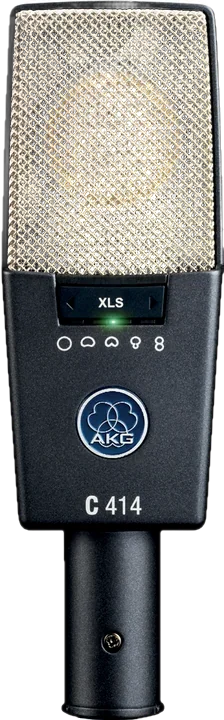
AKG
AKG C414 XLS
Large-diaphragm condenser, nine patterns
Approximate Some readings for this mic are uncertain; see the graphs.
Power Phantom, 48 V (IEC 61938) only.
- Type
- Condenser
- Pattern
- Switchable, 5
- Sensitivity
- −33 dBV/Pa
- Among 204 condensers: more output than 79%
- Among 311 mics: more output than 86%
- Self-noise
- 6 dB(A)
- Among 258 condensers: quieter than 95%
- Among 272 mics: quieter than 95%
- Max SPL
- 140 dB SPL
- Among 277 condensers: takes louder sound than 62%
- Among 343 mics: takes louder sound than 56%
- Rated range
- 20 – 20k Hz
vs 75 side-address condensers
More output than 70% of 75 side-address condensers.
Each stripe is one side-address condenser with a published sensitivity, and each bar counts them; further right means more output. This mic is in blue.
vs 99 side-address condensers
Quieter than 89% of 99 side-address condensers.
Each stripe is one side-address condenser with a published self-noise, and each bar counts them; further right means quieter. This mic is in blue.
vs 107 side-address condensers
Takes louder sound than 60% of 107 side-address condensers.
Each stripe is one side-address condenser with a published max SPL, and each bar counts them; further right means it takes louder sound. This mic is in blue.
Instruments sources recommend it for most
2 of 3; all under Recommended for.
Proximity effect: the bass it gains up close
From the manual, p. 47.
Data sheet titled with the model and pattern; distance, anechoic or not, smoothing and typical-vs-individual not stated.
That unit is from the Multi-Angle, Multi-Distance Microphone Impulse Response Dataset (CC BY 4.0), measured at 1.25 m and set to 0 dB at 1 kHz, from 136 Hz up. Not the manufacturer's curve.
Dashed: outside the rated range, or simulated (other angles and distances). Hover or tap the graphs for values.
Polar pattern
From the manual, p. 47. Approximate
Two halves: low frequencies on the left, high on the right (as the legend groups them); 0° at the bottom, rings every 5 dB labelled 0, -10, -20 dB. Measuring conditions not stated.
Approximate: reading error up to about 1.5 dB.
In practice
All specs
| From the manual | ||
|---|---|---|
| Capsule | 1-inch large diaphragm, dual-diaphragm"A dual-diaphragm transducer allows you to select one of several polar patterns" (p. 29). | p. 46 |
| Sensitivity | −33 dBV/Pa (23 mV/Pa)"-33 dBV ± 0.5 dB". | |
| Self-noise | 6 dB(A)IEC 60268-4, no pad | |
| Max SPL | 140 dB SPL0.5% THD, no pad; also 146 dB SPL, -6 dB pad; also 152 dB SPL, -12 dB pad; also 158 dB SPL, -18 dB pad. 200/400/800/1600 Pa. | |
| Signal-to-noise ratio | 88 dBre 1 Pa, A-weighted | |
| Dynamic range | 134 dBA-weighted, minimum | |
| Output impedance | 200 ohmmaximum. "≤ 200 ohms". | |
| Rated load impedance | 2200 ohmminimum recommended | |
| Rated frequency range | 20 Hz to 20 kHz"see frequency response graphs". | |
| Powering | phantom, 48 V (IEC 61938) onlyp. 33: "limit the powering options for both microphones to 48 V phantom power to IEC 61938 only". | |
| Current draw | 4.5 mAapproximate | |
| Low cut | off, 40 Hz, 80 Hz, 160 Hz12 dB/octave at 40 and 80 Hz; 6 dB/octave at 160 Hz. | |
| Pad | −6 dBalso −12 dB; also −18 dB. Selectable: -6, -12 or -18 dB. | |
| Switches | Lock mode: off, onHold the pattern selector for 2 s to lock all three selectors. | p. 29 |
| Connector | XLR-3"IEC standard 3-pin XLR". | p. 46 |
| Weight | 300 g | |
| Dimensions | 50 × 38 × 160 mmWidth × depth × height. | |
| Supplied accessories | H85 shock mount; PF80 pop screen; W414 X foam windscreen; Original frequency response trace with serial number; Carrying case | p. 28 |
| Equivalent noise levelIEC 60268-4 | 20 dB, no pad; weighting not named (the A-weighted figure, 6 dB(A), is listed separately) | p. 46 |
| Max. output level | 5 V rms (+14 dBV), A-weighted | |
| Overload indicator | Pattern LED turns red for about 3 s when the output comes within about 2 dB of the overload limit (peak hold) | p. 32 |
| Settling time | A changed pattern or pad takes about 10 to 15 s to become fully active | p. 31 |
| Environment | -10 °C to +60 °C; RH 95% (+20 °C), 85% (+60 °C) | p. 46 |
| Sound | Very smooth response, the typical AKG large-diaphragm sound; for most instruments | p. 34 |
Documents
- C414 XLS / C414 XLII manualDE, EN, FR
- Multi-Angle, Multi-Distance Microphone Impulse Response DatasetJuan Carlos Franco Hernández, Bogdan Bacila, Tim Brookes, Enzo De Sena, University of Surrey
Copies kept by Mic Archive (manufacturers move and drop their documents), unchanged, with their original addresses. Each is © its publisher.
Recommended for
By recording guides, engineers and mic makers, for this mic or an earlier version of it.