AKG
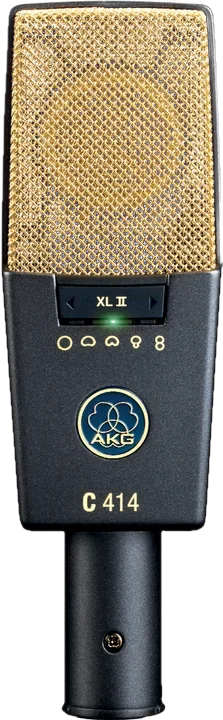
AKG C414 XLII
Large-diaphragm condenser, nine patterns, with a presence boost
Power Phantom, 48 V (IEC 61938) only.
- Type
- Condenser
- Pattern
- Switchable, 5
- Sensitivity
- −33 dBV/Pa
- Among 204 condensers: more output than 79%
- Among 311 mics: more output than 86%
- Self-noise
- 6 dB(A)
- Among 258 condensers: quieter than 95%
- Among 272 mics: quieter than 95%
- Max SPL
- 140 dB SPL
- Among 277 condensers: takes louder sound than 62%
- Among 343 mics: takes louder sound than 56%
- Rated range
- 20 – 20k Hz
- Released
- 2009
vs 75 side-address condensers
More output than 70% of 75 side-address condensers.
Each stripe is one side-address condenser with a published sensitivity, and each bar counts them; further right means more output. This mic is in blue.
vs 99 side-address condensers
Quieter than 89% of 99 side-address condensers.
Each stripe is one side-address condenser with a published self-noise, and each bar counts them; further right means quieter. This mic is in blue.
vs 107 side-address condensers
Takes louder sound than 60% of 107 side-address condensers.
Each stripe is one side-address condenser with a published max SPL, and each bar counts them; further right means it takes louder sound. This mic is in blue.
Instruments sources recommend it for most
2 of 4; all under Recommended for.
Proximity effect: the bass it gains up close
From the manual, p. 47.
Data sheet titled with the model and pattern; distance, anechoic or not, smoothing and typical-vs-individual not stated.
Dashed: outside the rated range, or simulated (other angles and distances). Hover or tap the graphs for values.
In practice
All specs
| From the manual | ||
|---|---|---|
| Capsule | 1-inch large diaphragm, dual-diaphragm"A dual-diaphragm transducer allows you to select one of several polar patterns" (p. 29). | p. 46 |
| Sensitivity | −33 dBV/Pa (23 mV/Pa)"-33 dBV ± 0.5 dB". | |
| Self-noise | 6 dB(A)IEC 60268-4, no pad | |
| Max SPL | 140 dB SPL0.5% THD, no pad; also 146 dB SPL, -6 dB pad; also 152 dB SPL, -12 dB pad; also 158 dB SPL, -18 dB pad. 200/400/800/1600 Pa. | |
| Signal-to-noise ratio | 88 dBre 1 Pa, A-weighted | |
| Dynamic range | 134 dBA-weighted, minimum | |
| Output impedance | 200 ohmmaximum. "≤ 200 ohms". | |
| Rated load impedance | 2200 ohmminimum recommended | |
| Rated frequency range | 20 Hz to 20 kHz"see frequency response graphs". | |
| Powering | phantom, 48 V (IEC 61938) onlyp. 33: "limit the powering options for both microphones to 48 V phantom power to IEC 61938 only". | |
| Current draw | 4.5 mAapproximate | |
| Low cut | off, 40 Hz, 80 Hz, 160 Hz12 dB/octave at 40 and 80 Hz; 6 dB/octave at 160 Hz. | |
| Pad | −6 dBalso −12 dB; also −18 dB. Selectable: -6, -12 or -18 dB. | |
| Switches | Lock mode: off, onHold the pattern selector for 2 s to lock all three selectors. | p. 29 |
| Connector | XLR-3"IEC standard 3-pin XLR". | p. 46 |
| Weight | 300 g | |
| Dimensions | 50 × 38 × 160 mmWidth × depth × height. | |
| Supplied accessories | H85 shock mount; PF80 pop screen; W414 X foam windscreen; Original frequency response trace with serial number; Carrying case | p. 28 |
| Equivalent noise levelIEC 60268-4 | 20 dB, no pad; weighting not named (the A-weighted figure, 6 dB(A), is listed separately) | p. 46 |
| Max. output level | 5 V rms (+14 dBV), A-weighted | |
| Overload indicator | Pattern LED turns red for about 3 s when the output comes within about 2 dB of the overload limit (peak hold) | p. 32 |
| Settling time | A changed pattern or pad takes about 10 to 15 s to become fully active | p. 31 |
| Environment | -10 °C to +60 °C; RH 95% (+20 °C), 85% (+60 °C) | p. 46 |
| Sound | Same as the C414 XLS except a different acoustic resistor: a slight rise at 3 kHz and above, close to the sound of the AKG C12; recommended for solo voice and solo instruments | p. 32 |
| From the Recording Hacks page | ||
| Released | 2009 | |
Documents
- C414 XLS / C414 XLII manualDE, EN, FR
- AKG Acoustics C 414 XL II | RecordingHacks.com
Copies kept by Mic Archive (manufacturers move and drop their documents), unchanged, with their original addresses. Each is © its publisher.
Recommended for
By recording guides, engineers and mic makers, for this mic or an earlier version of it.