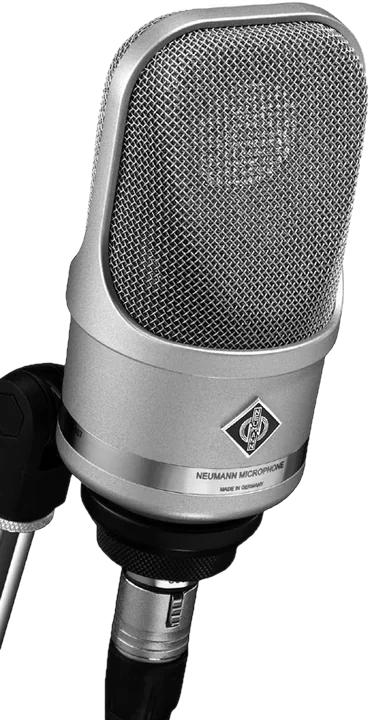
Neumann
Neumann TLM 107
Large-diaphragm condenser, five patterns, transformerless; pad and low cut set with a navigation switch
Power Phantom, 48 V (P48, IEC 61938).
- Type
- Condenser
- Pattern
- Switchable, 5
- Sensitivity
- −39.2 dBV/Pa
- Among 204 condensers: more output than 41%
- Among 311 mics: more output than 58%
- Self-noise
- 10 dB(A)
- Among 258 condensers: quieter than 81%
- Among 272 mics: quieter than 82%
- Max SPL
- 141 dB SPL
- Among 277 condensers: takes louder sound than 71%
- Among 343 mics: takes louder sound than 69%
- Rated range
- 20 – 20k Hz
- Released
- 2013
vs 75 side-address condensers
More output than 24% of 75 side-address condensers.
Each stripe is one side-address condenser with a published sensitivity, and each bar counts them; further right means more output. This mic is in blue.
vs 99 side-address condensers
Quieter than 61% of 99 side-address condensers.
Each stripe is one side-address condenser with a published self-noise, and each bar counts them; further right means quieter. This mic is in blue.
vs 107 side-address condensers
Takes louder sound than 73% of 107 side-address condensers.
Each stripe is one side-address condenser with a published max SPL, and each bar counts them; further right means it takes louder sound. This mic is in blue.
Instruments sources recommend it for most
Proximity effect: the bass it gains up close
From the manual, p. 10.
Free field, IEC 60268-4; tolerance ±2 dB (as printed under the graphs). Distance not stated.
Dashed: outside the rated range, or simulated (other angles and distances). Hover or tap the graphs for values.
Polar pattern
From the manual, p. 11.
Free field, IEC 60268-4. Each curve is drawn on one side only (125 Hz to 1 kHz left, 2 to 16 kHz right); the pattern is taken as symmetric. Rings every 5 dB, centre -25 dB.
In practice
All specs
| From the manual | ||
|---|---|---|
| Sensitivity | −39.2 dBV/Pa (11 mV/Pa)1 kHz into 1 kohm. Stated as 11 mV/Pa; converted: 20·log10(0.011) = -39.2. | p. 8 |
| Self-noise | 10 dB(A)IEC 60268-1, A-weighted RMS. "Equivalent noise level, A-weighted 10 dB-A". | |
| Self-noiseCCIR 468 | 22 dBCCIR 468-3 quasi-peak | |
| Max SPL | 141 dB SPLTHD < 0.5%; also 147 dB SPL, with pre-attenuation -6 dB; also 153 dB SPL, with pre-attenuation -12 dB. "Max. SPL for THD < 0.5 % 141 dB; with preattenuation –6 dB 147 dB; with preattenuation –12 dB 153 dB": "THD of microphone amplifier at an input voltage equivalent to the capsule output at the specified SPL". | |
| Signal-to-noise ratio | 84 dBre 94 dB SPL, A-weighted; also 72 dB, CCIR | |
| Output impedance | 50 ohmrated | |
| Rated load impedance | 1000 ohmrated load | |
| Rated frequency range | 20 Hz to 20 kHz"Frequency range 20 Hz to 20 kHz"; p. 7: "The frequency response of the TLM 107 extends below 20 Hz." | |
| Powering | phantom, 48 V (P48, IEC 61938)"Power Supply P48"; any P48 supply giving at least 3.5 mA per channel (p. 7). The product page: "48 V ± 4 V". | p. 9 |
| Current draw | 3.2 mA | |
| Low cut | off, 40 Hz, 100 Hz"A high-pass filter with a cutoff frequency of –3 dB can be selected for 40 Hz or 100 Hz by activating the switch toward the right." The graphs label the positions LIN, 40 and 100; "off" here is LIN. | p. 6 |
| Pad | −6 dBalso −12 dB. "pre-attenuation of –6 dB or –12 dB can be set by activating the switch toward the left". The troubleshooting table (p. 8) says "–6dB or –10dB", a slip. Not shown in the graphs. | |
| Connector | XLR-3"Required connectors XLR 3 F"; balanced transformerless output, pin 1 ground, pin 2 +, pin 3 -. | p. 9 |
| Weight | 445 g | |
| Dimensions | 64 × 145 mmPrinted as "Ø 64 x 145 mm": diameter x length. | |
| Supplied accessories | SG 2 stand mountEquipment supplied: "TLM 107 (bk) microphone, SG 2 stand mount, Operating manual"; the Studio Set has the EA 4 elastic suspension instead. The product page's order info also lists a wooden box. | p. 6 |
| Max. output voltage | 10 dBu | p. 9 |
| Controls | One navigation switch on the back: up/down for pattern, right for low cut, left for pad; LEDs show the settings and go dark after 15 s | p. 6 |
| Pattern remote | No remote pattern control: the N 248 is a phantom supply only | p. 9 |
| Cable length | Up to 300 m; longer cables may affect the frequency response | p. 7 |
| Operating temperature | 0 °C to +70 °C | p. 8 |
| Selected accessories | EA 4 elastic suspension, MNV 87 auditorium hanger, DS 120 and SG 2 mounts, MF 4 / MF 5 stands, PS 15 / PS 20 a popscreens, WS 47 foam windscreen, BS 48 i battery supplies, N 248 power supply, IC 3 mt / IC 4 cables | p. 9 |
| From the product page | ||
| Capsule | Dual-diaphragm large-diaphragm capsule, developed for the TLM 107"The newly developed dual diaphragm condenser capsule is specially designed for the TLM 107". The manual (p. 6): "a large double-diaphragm capsule" with "a flat frequency response up to approximately 8 kHz, and above this ... a wide, flat presence boost". | |
| Dynamic range | 131 dB"with a dynamic range of 131 dB the TLM 107 captures anything from a slight whisper to massive drums". The manual gives no figure. | |
| Versions | TLM 107 (nickel, Cat. No. 008666), TLM 107 bk (black, 008667), each also as a Studio Set with the EA 4 suspension | |
| From the Recording Hacks page | ||
| Released | 2013 | |
Documents
- TLM 107 Bedienungsanleitung / Operating Manual, Publ. 06/16552987/A03
- TLM 107neumann.com
- Neumann TLM 107 | RecordingHacks.com
Copies kept by Mic Archive (manufacturers move and drop their documents), unchanged, with their original addresses. Each is © its publisher.
Recommended for
By recording guides, engineers and mic makers, for this mic or an earlier version of it.