DPA Microphones
DPA d:facto 4018V
Handheld supercardioid condenser vocal mic (pre-polarised 19 mm capsule, 3 dB soft boost at 12 kHz) on DPA's wired XLR handle
Approximate Some readings for this mic are uncertain; see the graphs.
Power P48.
- Type
- Condenser (electret)
- Pattern
- Supercardioid
- Sensitivity
- −46 dBV/Pa
- Among 204 condensers: more output than 16%
- Among 311 mics: more output than 41%
- Self-noise
- 19 dB(A)
- Among 258 condensers: quieter than 29%
- Among 272 mics: quieter than 28%
- Max SPL
- 136 dB SPL
- Among 277 condensers: takes louder sound than 45%
- Among 343 mics: takes louder sound than 42%
- Rated range
- 20 – 20k Hz
vs 14 handheld condensers
More output than 69% of 14 handheld condensers.
Each stripe is one handheld condenser with a published sensitivity, and each bar counts them; further right means more output. This mic is in blue.
vs 12 handheld condensers
Quieter than 73% of 12 handheld condensers.
Each stripe is one handheld condenser with a published self-noise, and each bar counts them; further right means quieter. This mic is in blue.
vs 14 handheld condensers
Takes louder sound than 8% of 14 handheld condensers.
Each stripe is one handheld condenser with a published max SPL, and each bar counts them; further right means it takes louder sound. This mic is in blue.
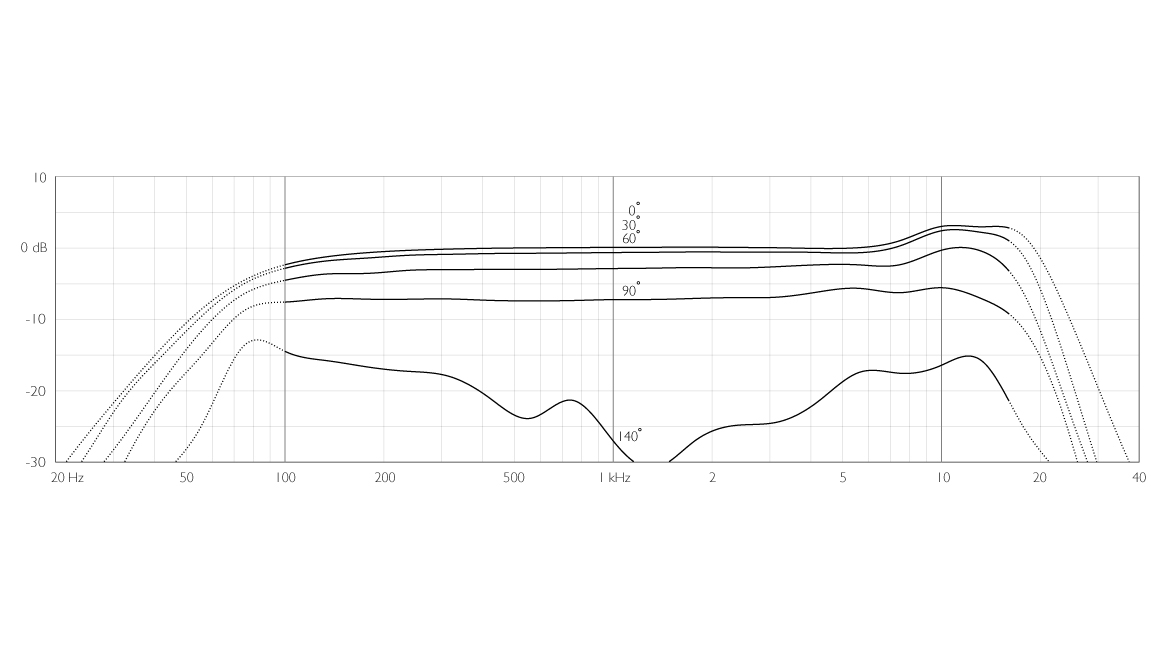
Proximity effect: the bass it gains up close
From the response image.
Captioned (on the product page) "Typical on and off-axis response of a d:facto™ 4018V microphone. On-axis (0°) measured at 12 cm (4.7 in), other directions measured in the far field." Drawn solid from 100 Hz to 16 kHz, dotted outside.
Dashed: outside the rated range, or simulated (other angles and distances). Hover or tap the graphs for values.
Polar pattern
From the polar image. Approximate
Captioned (on the product page) "Typical directional characteristics of a d:facto™ 4018V"; 5 dB per ring, centre -25 dB. Measuring conditions not stated.
Approximate: reading error up to about 1 dB; some frequencies are identified by reasoning, not by the legend: 250 Hz.
In practice
All specs
| From the product page | ||
|---|---|---|
| Capsule | Pre-polarised capsule, 19 mm"Capsule diameter: 19 mm (0.75 in)". | |
| Sensitivity | −46 dBV/Pa (5 mV/Pa)nominal, ±2 dB at 1 kHz; also −54 dBV/Pa, with the adapter for wireless. "5 mV/Pa; -46 dB re. 1 V/Pa. 2 mV/Pa; -54 dB re. 1 V/Pa with Adapter for wireless". | |
| Self-noise | 19 dB(A)typ. (max. 21 dB(A)) | |
| Max SPL | 136 dB SPLTHD < 1%, RMS; also 139 dB SPL, THD < 1%, peak; also 160 dB SPL, THD 10%, peak. "Distortion, THD < 1%: 136 dB SPL RMS, 139 dB SPL peak"; "Max. SPL, THD 10%: 160 dB SPL peak". | |
| Dynamic range | 120 dBtyp. | |
| Output impedance | 100 ohmrated | |
| Rated frequency range | 20 Hz to 20 kHz"Frequency response: 20 Hz - 20 kHz"; "Effective frequency range ±2 dB, at 12 cm (4.7 in): 40 Hz - 16 kHz with 3 dB soft boost at 12 kHz". | |
| Powering | P48"Power supply (for full performance): P48 (Phantom Power)". | |
| Current draw | 2 mAmax. | |
| Connector | XLR-3M"XLR-3M. Pin 1: shield, Pin 2: signal + phase, Pin 3: - phase". | |
| Weight | 309 g"309 g (10.9 oz)". | |
| Dimensions | 52 × 205 mmMicrophone diameter 52 mm, length 205 mm; capsule diameter 19 mm. | |
| Effective frequency range | ±2 dB at 12 cm: 40 Hz - 16 kHz with 3 dB soft boost at 12 kHz | |
| Output balance | Impedance balancing with Active Drive | |
| CMRR | > 50 dB at 1 kHz | |
| Maximum output voltage | 8 V RMS | |
| Cable drive capability | 100 m (328 ft) | |
| Polarity | +V at pin 2 for positive sound pressure | |
| Temperature range | -40 °C to 45 °C | |
| Relative humidity | Up to 90% | |
| From the product page 4018vl | ||
| Linear version4018VL | d:facto 4018VL: the same specifications, but 40 Hz - 16 kHz without the soft boost | |
Documents
- d:facto 4018V Softboost Vocal Microphoneproduct page specifications
- d:facto 4018VL Linear Vocal Microphoneproduct page specifications
- Typical on and off-axis response of a d:facto 4018V microphonegraph image
- Typical directional characteristics of a d:facto 4018Vgraph image

Copies kept by Mic Archive (manufacturers move and drop their documents), unchanged, with their original addresses. Each is © its publisher.