Sennheiser
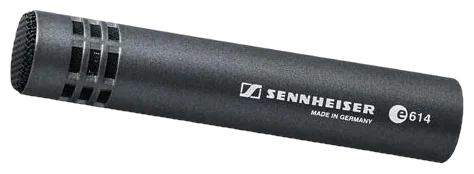
Sennheiser e 614
Pre-polarised (electret) condenser, supercardioid, compact pencil mic for overheads, hi-hat and percussion
Power Phantom, 12 to 52 V.
- Type
- Condenser (electret)
- Pattern
- Supercardioid
- Sensitivity
- −50.5 dBV/Pa
- Among 204 condensers: more output than 6%
- Among 311 mics: more output than 32%
- Self-noise
- 24 dB(A)
- Among 258 condensers: quieter than 11%
- Among 272 mics: quieter than 10%
- Max SPL
- 139 dB SPL
- Among 277 condensers: takes louder sound than 58%
- Among 343 mics: takes louder sound than 53%
- Rated range
- 40 – 20k Hz
vs 75 end-address condensers
More output than 1% of 75 end-address condensers.
Each stripe is one end-address condenser with a published sensitivity, and each bar counts them; further right means more output. This mic is in blue.
vs 104 end-address condensers
Quieter than 6% of 104 end-address condensers.
Each stripe is one end-address condenser with a published self-noise, and each bar counts them; further right means quieter. This mic is in blue.
vs 110 end-address condensers
Takes louder sound than 59% of 110 end-address condensers.
Each stripe is one end-address condenser with a published max SPL, and each bar counts them; further right means it takes louder sound. This mic is in blue.
Proximity effect: the bass it gains up close
From the manual (Recording Hacks copy), p. 6.
Titled "Frequency response curve"; drawn as absolute sensitivity (dBV). Room and smoothing not stated.
The manufacturer draws absolute sensitivity (dBV/Pa); shifted here by a constant so 1 kHz is near 0 dB.
Dashed: outside the rated range, or simulated (other angles and distances). Hover or tap the graphs for values.
Polar pattern
From the spec sheet, p. 2.
Titled "Polar pattern". Each frequency is drawn on one side only (125 to 1000 Hz left, 2000 to 16000 Hz right); the pattern is taken as symmetric. Measuring conditions not stated.
In practice
All specs
| From the spec sheet | ||
|---|---|---|
| Sensitivity | −50.5 dBV/Pa (3 mV/Pa)free field, 1 kHz. "3 mV/Pa"; converted (20 log10 0.003). The manual adds "no load". | p. 1 |
| Self-noise | 24 dB(A)equivalent noise level, A-weighted | |
| Self-noiseCCIR 468 | 35 dBequivalent noise level, CCIR-weighted | |
| Max SPL | 139 dB SPL1 kHz; distortion not stated. The 2004 manual gives the same: "139 dB/SPL" at 1 kHz. | |
| Output impedance | 50 ohmnominal, 1 kHz | |
| Rated load impedance | 1000 ohmminimum. "Min. terminating impedance 1 kΩ". | |
| Rated frequency range | 40 Hz to 20 kHz | |
| Connector | XLR-3 | |
| Weight | 93 g"93 g". The manual also says 93 g. | |
| Dimensions | 20 × 100 mm"⌀ 20 x 100 mm": diameter × length. The drawing on page 2 gives 98.9 mm long. The US product sheet prints ".70" x 3.94"". | |
| Supplied accessories | MZQ 100 microphone clamp; pouch"Delivery includes". | |
| From the manual (Recording Hacks copy) | ||
| Powering | phantom, 12 to 52 V"Phantom powering 12 – 52 V / 3 mA". The 2021 spec sheet table says "12 - 48 V", its architect's text "12 – 52 V". | p. 7 |
| Current draw | 3 mA | |
| PlacementSennheiser | Hi-hat: a few centimetres above the outer edge, aiming down, not too close to the edge (air blast when the hi-hat closes); high-pass filter if needed. Point the angle of most rejection (about 135°) at other sources. | p. 5 |
| From the spec sheet (Recording Hacks copy) | ||
| Front-to-back rejection | > 15 dB at 1 kHz, at 135° | p. 1 |
Documents
- evolution wired e 614 Product SpecificationSP 1207 v1.1
- e 614 Instructions for usePubl. 09/04, 511652/A01
- Evolution e 614 Overhead MicrophoneUS product sheet
Copies kept by Mic Archive (manufacturers move and drop their documents). Each is © Sennheiser, unchanged, with its original address.
Other mics
More from Sennheiser
- Sennheiser MD 421
- Sennheiser MD 441 U
- Sennheiser MKH 40 P48
- Sennheiser e 604
- Sennheiser MKH 20 P48
- Sennheiser e 602-II
- Sennheiser e 902
- Sennheiser e 965