Sennheiser
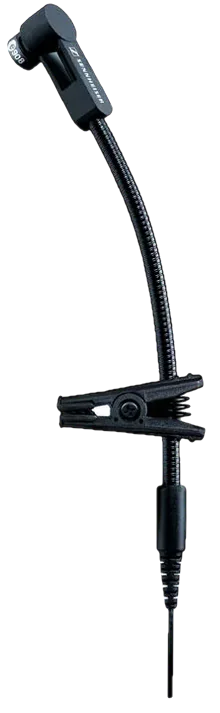
Sennheiser e 908 B
Miniature cardioid condenser clip-on for brass, on a long gooseneck with a bell clamp; MZA 900 P in-line phantom adapter
Approximate Some readings for this mic are uncertain; see the graphs.
Power Phantom 12-48 V, through the MZA 900 P.
- Type
- Condenser (electret)
- Pattern
- Cardioid
- Sensitivity
- −48 dBV/Pa
- Among 204 condensers: more output than 12%
- Among 311 mics: more output than 37%
- Self-noise
- 35 dB(A)
- Among 258 condensers: quieter than 1%
- Among 272 mics: quieter than 1%
- Max SPL
- 147 dB SPL
- Among 277 condensers: takes louder sound than 86%
- Among 343 mics: takes louder sound than 84%
- Rated range
- 40 – 20k Hz
vs 16 clip-on condensers
More output than 53% of 16 clip-on condensers.
Each stripe is one clip-on condenser with a published sensitivity, and each bar counts them; further right means more output. This mic is in blue.
vs 14 clip-on condensers
Quieter than 0% of 14 clip-on condensers.
Each stripe is one clip-on condenser with a published self-noise, and each bar counts them; further right means quieter. This mic is in blue.
vs 16 clip-on condensers
Takes louder sound than 53% of 16 clip-on condensers.
Each stripe is one clip-on condenser with a published max SPL, and each bar counts them; further right means it takes louder sound. This mic is in blue.
Proximity effect: the bass it gains up close
From the spec sheet, p. 2.
"Frequency response" graph, absolute sensitivity in dBV/Pa; legend "1 m, 0°", "1 m, 90°", "1 m, 180°", "10 cm, 0°". Room and smoothing not stated.
The manufacturer draws absolute sensitivity (dBV/Pa); shifted here by a constant so 1 kHz is near 0 dB.
Dashed: outside the rated range, or simulated (other angles and distances). Hover or tap the graphs for values.
Polar pattern
From the spec sheet, p. 2. Approximate
Titled "Polar pattern". Each frequency is drawn on one side only (125 to 1000 Hz left, 2000 to 16 000 Hz right); the pattern is taken as symmetric. Measuring conditions not stated.
Approximate: some frequencies are identified by reasoning, not by the legend: 125 Hz.
In practice
All specs
| From the spec sheet | ||
|---|---|---|
| Sensitivity | −48 dBV/Pa (4 mV/Pa)free field, 1 kHz. "4 mV/Pa"; converted (20 log10 0.004). The 2006 manual: "4.0 mV/Pa (free field, no load at 1 kHz)"; e 908 T ew 0.56 mV/Pa. | p. 1 |
| Self-noise | 35 dB(A)with the MZA 900 P; also 30 dB(A), e 908 B ew, direct. "Equivalent noise level 30 dB(A), 35 dB(A)*", * with MZA 900 P. The 2006 manual: e 908 B and D 35 dB(A), B ew 30 dB(A), T ew 39 dB(A), "A-weighted as per DIN IEC 651". | |
| Max SPL | 147 dB SPLk = 3%. "147 dBSPL (k = 3%)". The 2006 manual: "at 1 kHz 147 dB/SPL". | |
| Output impedance | 100 ohmnominal, 1 kHz, balanced, with the MZA 900 P | |
| Rated load impedance | 50 ohmminimum, with the MZA 900 P; also 2000 ohm, 2006 manual and 2009 sheet. "Min. terminating impedance 50 Ω". The 2006 manual and 2009 sheet say 2 kΩ, and the quick guide gives the MZA 900 P a min. load impedance of 5 kΩ (0 dB) or 2 kΩ (-12 dB) (page 2), so 50 Ω looks doubtful. | |
| Rated frequency range | 40 Hz to 20 kHz | |
| Powering | phantom 12-48 V, through the MZA 900 P"Phantom powering 12 - 48 V*", * with MZA 900 P. The quick guide gives the MZA 900 P "P12 – P48; 10 – 52 V; 2.6 – 2.8 mA" (page 2). | |
| Connector | XLR-3 on the MZA 900 P; the mic cable ends in a locking 3.5 mm jack"XLR-3*" (with MZA 900 P) for the e 908 B, "3.5 mm jack" for the e 908 B ew. Page 2 drawing: "Stereo miniature plug 3,5 mm with locking screw". | |
| Weight | 140 g"140 g"; the quick guide prints "140 g*", * with MZA 900 P. The 2006 manual and 2009 sheet say 311 g. | |
| Supplied accessories | MZH 908 B microphone clamp; MZA 900 P phantom adapter; pouch; windshield"Delivery includes" (the MZA 900 P with the e 908 B only). | |
| Dimensions | Ø 47 x 193 mm | |
| From the quick guide | ||
| Low cut | off, 125 Hz, 12 dB/octave; 125 Hz; 12 dB/octaveOn the MZA 900 P: "Roll-off filter, switchable 125 Hz (- 3 dB), 12 dB/oct.". | p. 2 |
| Pad | −12 dBOn the MZA 900 P: "Gain, switchable 0/-12 dB". | |
| MZA 900 P adapter | Frequency response 20-20,000 Hz (-1 dB); max. output 1.8 V (P48), 0.6 V (P12) at 0 dB gain, 0.45 V at -12 dB; output noise 3 µV A-weighted, 12 µV CCIR; output impedance 100 Ω; LED for operating and error; Ø 22 x 100 mm, 60 g | |
| Operating conditionsMZA 900 P | -20 to +60 °C, < 95% relative humidity | |
| From the manual (Recording Hacks copy) | ||
| Current draw | 3 mAwith the MZA 900 P. "12–48 V / 3 mA*". The quick guide: 2.6-2.8 mA for the MZA 900 P. | p. 9 |
| Mount | Long flexible gooseneck, shock-mounted head; MZH 908 B clamp for instrument bells (also usable on drums with suspension mounts and congas) | p. 2 |
| PlacementSennheiser | Saxophone: aim partly at the bell and partly at the body; into the bell for less spill. Drums (e 908 D): 3-5 cm above the head, aimed at the centre, at 30-60° for the most balanced sound | p. 4 |
| From the spec sheet (Recording Hacks copy) | ||
| Models | e 908 B (Art. no. 500203): with MZA 900 P, for brass. e 908 B ew (500204): no adapter, 3.5 mm jack for evolution wireless bodypacks. e 908 D: for drums and percussion, with the MZH 908 D drum clamp and MZA 900 P. e 908 T ew: for trumpets, flugelhorns and trombones on ew bodypacks, 0.56 mV/Pa, 39 dB(A) | p. 1 |
Documents
- evolution wired e 908 B | e 908 B ew Product SpecificationSP 1216 V1.1
- e 908 Quick GuidePubl. 03/25, 581336/A05
- e 908 product sheetMicrophones | evolution
- e 908 Instructions for usee 908 B / D / B ew / T ew
Copies kept by Mic Archive (manufacturers move and drop their documents). Each is © Sennheiser, unchanged, with its original address.
Other mics
More from Sennheiser
- Sennheiser MD 421
- Sennheiser MD 441 U
- Sennheiser MKH 40 P48
- Sennheiser e 604
- Sennheiser MKH 20 P48
- Sennheiser e 602-II
- Sennheiser e 902
- Sennheiser e 965