Shure
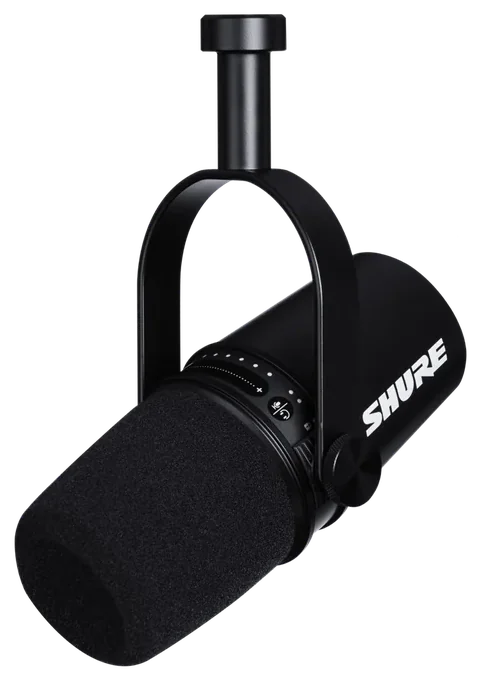
Shure MV7
Cardioid dynamic podcast mic with both an XLR output and a USB (Micro-B) digital output, touch panel and headphone jack
Approximate Some readings for this mic are uncertain; see the graphs.
Power USB or Lightning bus power for the USB output; none for the XLR output. Low output: it needs a lot of preamp gain.
- Type
- Dynamic
- Pattern
- Cardioid
- Sensitivity
- −55 dBV/Pa
- Among 78 dynamics: more output than 35%
- Among 311 mics: more output than 13%
- Max SPL
- 132 dB SPL
- Among 36 dynamics: takes louder sound than 9%
- Among 343 mics: takes louder sound than 24%
- Rated range
- 50 – 16k Hz
vs 44 end-address dynamics
More output than 44% of 44 end-address dynamics.
Each stripe is one end-address dynamic with a published sensitivity, and each bar counts them; further right means more output. This mic is in blue.
vs 19 end-address dynamics
Takes louder sound than 6% of 19 end-address dynamics.
Each stripe is one end-address dynamic with a published max SPL, and each bar counts them; further right means it takes louder sound. This mic is in blue.
Proximity effect: the bass it gains up close
From the user guide, p. 19.
Titled "Typical MV7 Frequency Response"; relative dB. Output (XLR or USB), gain, DSP mode, distance and smoothing are not stated.
Dashed: outside the rated range, or simulated (other angles and distances). Hover or tap the graphs for values.
Polar pattern
From the user guide, p. 20. Approximate
Titled "Typical MV7 Polar Pattern"; two plots, 250 Hz to 1 kHz and 2500 to 6300 Hz; 0° at the bottom, rings every 5 dB labelled -5 to -20 dB, centre -25 dB. Measuring conditions not stated.
Approximate: reading error up to about 1 dB.
In practice
All specs
| From the user guide | ||
|---|---|---|
| Sensitivity | −55 dBV/Pa (1.78 mV/Pa)XLR output; 1 kHz, open circuit voltage. "-55 dBV/Pa (1.78 mV), -47 dBFS/Pa"; the spec sheet labels them "XLR Sensitivity" and "USB Sensitivity". | p. 18 |
| Sensitivitydigital | −47 dBFSUSB output, 1 kHz, at minimum gain, flat mode. "-47 dBFS/Pa", footnote "At Minimum Gain, Flat Mode". | |
| Max SPL | 132 dB SPLUSB (digital) output, at minimum gain, flat mode. "Maximum SPL, Digital Output 132 dB SPL"; the spec sheet: "USB Maximum SPL 132 dB SPL". Not stated as the 0 dBFS point (-47 dBFS/Pa would put 0 dBFS at 141 dB SPL). | |
| Output impedance | 314 ohmXLR output, at 1 kHz. The spec sheet: "XLR Output Impedance 314 Ω at 1 kHz". | |
| Rated frequency range | 50 Hz to 16 kHz"MV7 Frequency Response 50 Hz to 16,000 Hz". | |
| Powering | USB or Lightning bus power for the USB output; none for the XLR outputPage 4: "No phantom power is required when using the MV7." | p. 19 |
| Weight | 550 gnet. "0.55 kg (1.21 lbs)". | |
| Supplied accessories | 95A45110 10 ft Micro-B to USB-A cable; 95B38076 10 ft Micro-B to USB-C cableFurnished accessories. | p. 22 |
| Adjustable gain range | 0 to +36 dB | p. 18 |
| DSP modespresets | Near/Far, Dark/Natural/Bright; EQ flat, high-pass, presence boost, or both; limiter; compressor (light, medium, heavy); Auto Level Mode | |
| Headphone output | 3.5 mm (1/8") | |
| Polarity | Positive pressure on diaphragm produces positive voltage on pin 2 with respect to pin 3 | |
| MFi certified | Yes | |
| Mute switch attenuation | Yes (touch panel) | |
| Mounting | 5/8"-27 thread mount on an integrated yoke | p. 19 |
| PlacementShure | Near: 1 to 6 inches (2.54 to 15 cm); Far: 6 to 18 inches (15 to 45 cm) | p. 8 |
| Touch panel LED levels | 8 LEDs: -6, -12, -18 (yellow), -24, -30, -39, -48, -90 dB (green) | p. 20 |
| Replacement parts | AMV7-K-WS black windscreen; AMV7-S-WS silver windscreen; optional AMV-LTG 1 m Lightning cable | p. 22 |
| From the spec sheet | ||
| Connector | Micro-B USB and XLR"Connector Type: Micro-B USB and XLR". | p. 1 |
| Dimensions | 164 × 153.6 × 90.2 mm"Mic in Yoke: 164 x 153.6 x 90.2 mm H × L x D". The microphone alone: "Length 53.6 mm; Diameter 66.5 mm" as printed. | |
| Finish | All-metal construction; black (MV7-K) or silver (MV7-S) | |
Documents
- MV7 Podcast Microphone, user guide
- MV7 Podcasting Microphone, spec sheet
Copies kept by Mic Archive (manufacturers move and drop their documents). Each is © Shure, unchanged, with its original address.