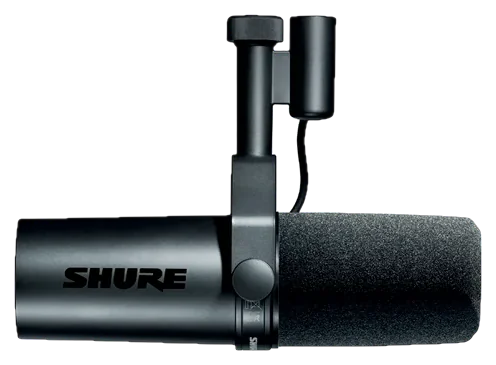
Shure
Shure SM7dB
Cardioid dynamic for speech, podcasts and vocals: the SM7B with a built-in active preamp (+18 or +28 dB, or bypassed)
Approximate Some readings for this mic are uncertain; see the graphs.
Power Phantom 48 V DC (IEC-61938) for the preamp; none in bypass mode. Low output: it needs a lot of preamp gain.
- Type
- Dynamic
- Pattern
- Cardioid
- Sensitivity
- −59 dBV/Pa
- Among 78 dynamics: more output than 13%
- Among 311 mics: more output than 5%
- Rated range
- 50 – 20k Hz
vs 44 end-address dynamics
More output than 19% of 44 end-address dynamics.
Each stripe is one end-address dynamic with a published sensitivity, and each bar counts them; further right means more output. This mic is in blue.
Proximity effect: the bass it gains up close
From the user guide, p. 10.
Titled "Typical Frequency Response"; relative dB. Distance, anechoic or not, smoothing and preamp setting are not stated (the guide calls the preamp's gain "flat").
Dashed: outside the rated range, or simulated (other angles and distances). Hover or tap the graphs for values.
Polar pattern
From the user guide, p. 10. Approximate
Titled "Typical Polar Pattern"; two plots, 250 Hz to 1 kHz and 2500 to 6300 Hz; 0° at the bottom, rings every 5 dB labelled -5 to -20 dB, centre -25 dB. Measuring conditions not stated.
Approximate: reading error up to about 1 dB.
In practice
All specs
| From the user guide | ||
|---|---|---|
| Sensitivity | −59 dBV/Pa (1.12 mV/Pa)flat response, preamp bypassed; 1 kHz, open circuit; also −41 dBV/Pa, flat response, preamp +18 dB; also −31 dBV/Pa, flat response, preamp +28 dB. Pages 8-9: "-59 dBV/Pa (1.12 mV)" bypass, "-41 dBV/Pa (8.91 mV)" +18, "-31 dBV/Pa (28.2 mV)" +28; all measured with 48 V phantom power. | p. 8 |
| Output impedance | 150 ohmpreamp bypassed; also 27 ohm, preamp engaged. Recommended load ">1k Ω". | |
| Rated load impedance | 1000 ohmrecommended, more than. "Recommended Load >1k Ω". | |
| Rated frequency range | 50 Hz to 20 kHzTolerance not stated. | |
| Powering | phantom 48 V DC (IEC-61938) for the preamp; none in bypass mode"48 V DC phantom power (IEC-61938) 4.5 mA, maximum"; page 3: "It will operate in bypass mode without phantom power." The footnote: "The microphone operates at lower voltages, but with slightly decreased headroom and sensitivity." | p. 9 |
| Current draw | 4.5 mAmaximum, preamp engaged | |
| Switches | bass roll-off: off, on; presence boost: off, on; preamp: bypass, +18 dB, +28 dBBack panel: bass roll-off, presence boost, a bypass switch and a preamp switch (+18 dB or +28 dB). | p. 6 |
| Connector | XLR-3 maleNot stated as such; the polarity is given for pins 2 and 3, and page 3 asks for "balanced, microphone-level inputs". | p. 9 |
| Weight | 837 g"0.837 kg (1.875 lbs)". | |
| Finish | Black enamel aluminium and steel case with black foam windscreen | |
| Supplied accessories | RK345B black foam windscreen; A7WS large black foam windscreen; 31A1856 5/8" to 3/8" thread adapterFurnished accessories. | p. 11 |
| Preamplifier equivalent input noise | -130 dBV (A-weighted, typical) | p. 9 |
| Hum pickup | 11 dB (typical, at 60 Hz, equivalent SPL/mOe) | |
| Polarity | Positive pressure on diaphragm produces positive voltage on pin 2 with respect to pin 3 | |
| Preamplifier | Built-in active preamp, "up to +28 dB of low-noise, flat, transparent gain"; switch positions +18 dB and +28 dB, or bypass | p. 3 |
| Variable-impedance preamps | Use the highest impedance setting with the built-in preamp; bypass it to change the tone with a low impedance setting | p. 4 |
| PlacementShure | Speak directly into the mic, 1 to 6 inches (2.54 to 15 cm) away | |
| Replacement parts | RK345B black windscreen; RPM604B nut and washers for the yoke mount | p. 11 |
| From the spec sheet | ||
| Replacement cartridge | RPM106B ("Internal Microphone Cartridge") | p. 1 |
Documents
- SM7dB Vocal Microphone with Active Preamp, user guideversion 4.1, 2025-H
- SM7dB Dynamic Vocal Microphone with Built-in Preamp, spec sheetSM7dB_SpecSheet_EN
Copies kept by Mic Archive (manufacturers move and drop their documents). Each is © Shure, unchanged, with its original address.
Recommended for
By recording guides, engineers and mic makers, for this mic or an earlier version of it.