Neumann
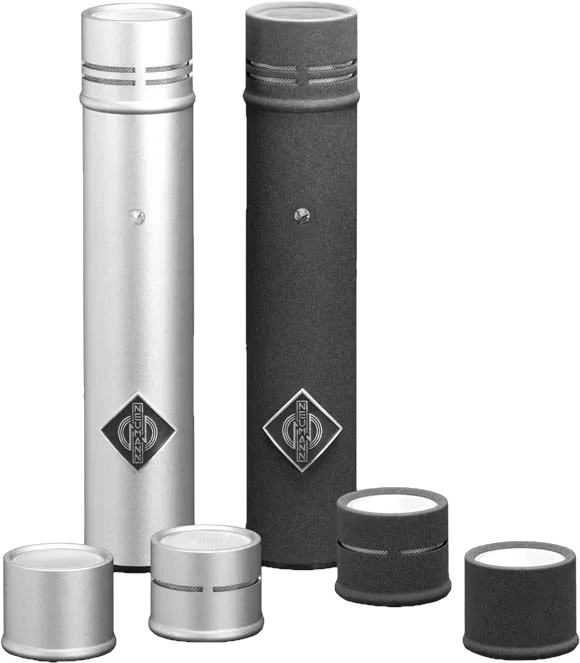
Neumann KM 184 D
Small-diaphragm condenser, cardioid, digital output (AES42)
Power Phantom power complying with AES 42, +7 V to +10.5 V.
- Type
- Condenser
- Pattern
- Cardioid
- Self-noise
- 13 dB(A)
- Among 258 condensers: quieter than 67%
- Among 272 mics: quieter than 68%
- Max SPL
- 133 dB SPL
- Among 277 condensers: takes louder sound than 32%
- Among 343 mics: takes louder sound than 29%
- Rated range
- 20 – 20k Hz
vs 104 end-address condensers
Quieter than 79% of 104 end-address condensers.
Each stripe is one end-address condenser with a published self-noise, and each bar counts them; further right means quieter. This mic is in blue.
vs 110 end-address condensers
Takes louder sound than 25% of 110 end-address condensers.
Each stripe is one end-address condenser with a published max SPL, and each bar counts them; further right means it takes louder sound. This mic is in blue.
Proximity effect: the bass it gains up close
From the manual, p. 10.
Distance and room not stated (the analogue KM 184 graph says free field, IEC 60268-4). The solid curve is the nominal response; the dashed lines are its tolerance band.
Dashed: outside the rated range, or simulated (other angles and distances). Hover or tap the graphs for values.
Polar pattern
From the manual, p. 10.
Conditions not stated. Each curve is drawn on one side only (125 Hz and 250 to 1000 Hz left, 2 to 16 kHz right); the pattern is taken as symmetric.
In practice
All specs
| From the manual | ||
|---|---|---|
| The table lists KM D + KK 131 / KK 143 / KK 145 / KM 183 D / KM 184 D / KM 185 D; this is the fifth value. | ||
| Capsule | KK 184 cardioid capsule (interchangeable; the KM D takes six capsules) | p. 5 |
| Sensitivitydigital | −39 dBFS1 kHz, 94 dB SPL, 0 dB pre-attenuation and 0 dB gain. | p. 6 |
| Self-noise | 13 dB(A)IEC 61672-1 A-weighting, RMS. | |
| Self-noiseCCIR 468 | 22 dBCCIR 468-3, quasi peak. | |
| Max SPL | 133 dB SPLat 0 dBFS, 0 dB pre-attenuation and 0 dB gain. The digital clipping point; the pre-attenuation (down to -18 dB) moves it up. | |
| Signal-to-noise ratio | 81 dBre 94 dB SPL, A-weighted; also 70 dB, re 94 dB SPL, CCIR 468-3. | |
| Rated frequency range | 20 Hz to 20 kHz | |
| Powering | phantom power complying with AES 42, +7 V to +10.5 V | |
| Current draw | 150 mAmax. | |
| Low cut | off, 40 Hz, 80 Hz, 160 HzRemote controlled ("High-pass filter"), set from the AES42 interface; off by default. | |
| Pad | −6 dBalso −12 dB; also −18 dB. Remote controlled pre-attenuation: 0, -6, -12 or -18 dB. | |
| Connector | XLR 3 M | |
| Weight | 84 gThe table lists 80/84/88/80/84/88 g; this is the fifth value. | |
| Dimensions | 22 × 108 mmDiameter × length. | |
| Supplied accessories | SG 21 bk stand mount; WNS 100 windscreen; wooden caseScope of delivery, single microphone. | p. 7 |
| A/D conversion | Neumann process (patented), 28-bit internal word length | p. 6 |
| Digital gain | 0 to 63 dB in 1 dB steps (remote controlled) | |
| Latency | 41 samples at 44.1/48 kHz; 49 at 88.2/96 kHz; 99 at 176.4/192 kHz | |
| Remote functions | Compressor/limiter, peak limiter, mute, polarity, test signals, LED brightness | |
Documents
- KM D digital miniature microphones (Solution-D), operating manual
Copies kept by Mic Archive (manufacturers move and drop their documents), unchanged, with their original addresses. Each is © its publisher.