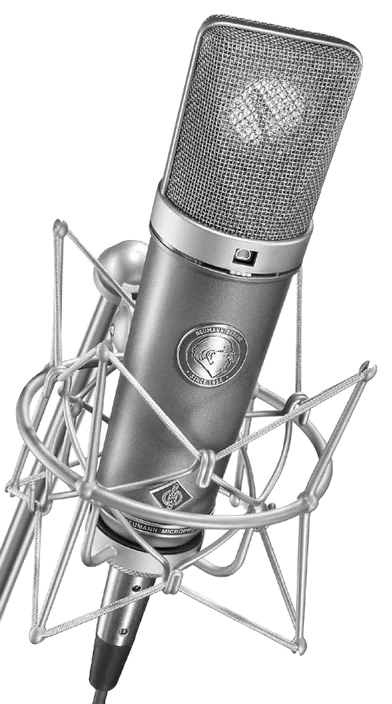
Neumann
Neumann TLM 67
Large-diaphragm condenser, three patterns, transformerless, with the K 67 capsule and a tube-like (EF 86) sound design
Power Phantom P48 (IEC 61938).
- Type
- Condenser
- Pattern
- Switchable, 3
- Sensitivity
- −35 dBV/Pa
- Among 204 condensers: more output than 64%
- Among 311 mics: more output than 75%
- Self-noise
- 11 dB(A)
- Among 258 condensers: quieter than 78%
- Among 272 mics: quieter than 79%
- Max SPL
- 105 dB SPL
- Among 277 condensers: takes louder sound than 0%
- Among 343 mics: takes louder sound than 0%
- Rated range
- 20 – 20k Hz
- Released
- 2008
vs 75 side-address condensers
More output than 55% of 75 side-address condensers.
Each stripe is one side-address condenser with a published sensitivity, and each bar counts them; further right means more output. This mic is in blue.
vs 99 side-address condensers
Quieter than 58% of 99 side-address condensers.
Each stripe is one side-address condenser with a published self-noise, and each bar counts them; further right means quieter. This mic is in blue.
vs 107 side-address condensers
Takes louder sound than 0% of 107 side-address condensers.
Each stripe is one side-address condenser with a published max SPL, and each bar counts them; further right means it takes louder sound. This mic is in blue.
Proximity effect: the bass it gains up close
From the manual, p. 14.
Free field, IEC 60268-4; tolerance ±2 dB (as printed under the graphs). Distance not stated.
Dashed: outside the rated range, or simulated (other angles and distances). Hover or tap the graphs for values.
Polar pattern
From the manual, p. 15.
Free field, IEC 60268-4 (as printed on the response page). Each curve is drawn on one side only (125 Hz to 1 kHz left, 2 to 16 kHz right); the pattern is taken as symmetric. Rings every 5 dB, centre -25 dB.
In practice
All specs
| From the manual | ||
|---|---|---|
| Values per pattern are printed as omni/cardioid/figure-8; the cardioid value is the main one here. | ||
| Self-noise | 11 dB(A)cardioid; IEC 60268-1, A-weighted per IEC 61672-1, RMS; also 16 dB(A), omni; also 17 dB(A), figure-8. | p. 10 |
| Self-noiseCCIR 468 | 24 dBcardioid; CCIR 468-3, quasi peak; also 29 dB, omni; also 30 dB, figure-8. | |
| Max SPL | 105 dB SPLcardioid; THD < 0.5%; also 110 dB SPL, omni; THD < 0.5%; also 111 dB SPL, figure-8; THD < 0.5%; also 125 dB SPL, cardioid; THD < 5%; also 130 dB SPL, omni; THD < 5%; also 131 dB SPL, figure-8; THD < 5%. "THD of microphone amplifier at an input voltage equivalent to the capsule output at the specified SPL". The product page calls these "Typical SPL (tube characteristic)" and explains: "a seemingly low max SPL figure of 105 dB (in cardioid mode) for 0.5% THD, but, like in a tube circuit, distortion rises gently to 5% THD for 125 dB SPL". The pad raises the limit by 10 dB (p. 8); no figures with the pad. | |
| Signal-to-noise ratio | 83 dBcardioid; re 94 dB SPL, A-weighted; also 78 dB, omni, A-weighted; also 77 dB, figure-8, A-weighted; also 70 dB, cardioid, CCIR; also 65 dB, omni, CCIR; also 64 dB, figure-8, CCIR. | |
| Output impedance | 50 ohmrated | |
| Rated load impedance | 1000 ohmrated load | |
| Rated frequency range | 20 Hz to 20 kHz"Frequency range 20 Hz to 20 kHz"; "The frequency response of the TLM 67 extends below 20 Hz" (p. 8). | |
| Powering | phantom P48 (IEC 61938)"Power Supply P48"; any P48 supply per IEC 61938 "which supplies at least 3.5 mA per channel" (p. 7). | |
| Current draw | 3 mA | |
| Low cut | off, on"The high-pass filter is activated by means of a switch on the back of the microphone" (p. 8). Its frequency and slope are not stated; the response graphs show its effect. | p. 8 |
| Pad | −10 dB"Pre-attenuation is activated by means of a switch on the back of the microphone. It increases the maximum signal level by 10 dB" (p. 8); troubleshooting: "Slide the pre-attenuation switch to –10dB" (p. 9). Not shown in the graphs. | |
| Connector | XLR-3"Required connectors: Microphone XLR3F"; balanced, transformerless output, pin 1 ground, pin 2 + (positive for a pressure rise on the front diaphragm), pin 3 -. | p. 10 |
| Weight | 490 g | |
| Dimensions | 56 × 200 mm"Ø 56 x 200 mm": diameter × length. | |
| Supplied accessories | case"Scope of delivery: TLM 67 microphone, Operating manual, Case". The product page’s order info lists "TLM 67 Microphone, Wooden Box". | p. 7 |
| Max. output voltage | -1 dBu | p. 10 |
| Circuit | Transformerless FET circuit with a special sound design reproducing characteristics of the U 67’s EF 86 tube | p. 7 |
| Pattern switching | Increased noise for up to about 30 s after switching, while the capsule recharges to the new bias | p. 8 |
| Cable length | Up to about 300 m without effect on the frequency response | |
| Operating conditions | 0 °C to +70 °C; storage -20 °C to +70 °C; humidity 0-90 % at +20 °C, 0-85 % at +60 °C (non-condensing) | p. 10 |
| Selected accessories | EA 87 elastic suspension; MNV 87 auditorium hanger; DS 120; MF 3, MF 4, MF 5 stands; WS 87 windscreen; PS 15, PS 20 a popscreens; BS 48 i, BS 48 i-2 battery supplies; N 248 power supply; IC 3 mt, IC 4 cables; AC 25 adapter | p. 11 |
| From the product page | ||
| Capsule | K 67 large dual-diaphragm capsule (pressure-gradient)"the classic K 67 capsule, also used in the Neumann U 87 A". The manual: "Pressure gradient transducer" (p. 10); "Use of the K 67 capsule" (p. 7). | |
| Finish | pearl grey body, satin nickel capsule headOrder info: "Color pearl grey/nickel"; "a unique dual color scheme, combining a capsule head in classic satin nickel with a stylish pearl-gray body". | |
| Cat. No. | TLM 67, pearl grey/nickel: 008605 | |
| Release | 2008 | |
| Applications | Vocals and spoken word; acoustic and electric guitar, piano, percussion, drum overheads | |
| From the Recording Hacks page | ||
| Released | 2008 | |
| From the quick guide | ||
| Sensitivity | −35 dBV/Pa (18 mV/Pa)cardioid, 1 kHz into 1 kohm; ± 1 dB; also −40 dBV/Pa, omni; also −41 dBV/Pa, figure-8. "10/18/9 mV/Pa −40/−35/−41 dBV ± 1 dB". Values per pattern are printed as omni/cardioid/figure-8; the cardioid value is the main one here. | p. 2 |
Documents
- TLM 67 Bedienungsanleitung / Operating Manual, Publ. 03/15527752/A01
- TLM 67 Quick Guide, 06/2018
- TLM 67neumann.com
- TLM 67 frequency diagram, omnidirectionalNeumann artwork file, 2017
- TLM 67 frequency diagram, cardioidNeumann artwork file, 2017
- TLM 67 frequency diagram, figure-8Neumann artwork file, 2017
- Neumann TLM 67 | RecordingHacks.com
Copies kept by Mic Archive (manufacturers move and drop their documents). Each is © Neumann, unchanged, with its original address.
Other mics
More from Neumann
- Neumann KM 184
- Neumann U 87 (U 87 i)
- Neumann KM 84
- Neumann TLM 103
- Neumann U 47
- Neumann U 67
- Neumann U 47 fet
- Neumann TLM 170 R