Shure
Shure PGA98H
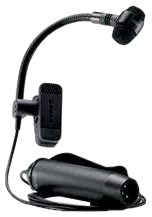
Clip-on cardioid electret condenser on a gooseneck with horn clamp, for wind instruments; in-line XLR preamp or TA4F (TQG) for bodypacks; PG Alta series
Power Phantom, 11 to 52 V DC (XLR version, through its in-line preamp); the TQG version runs from a bodypack supplying 5 V on pin 2.
- Type
- Condenser (electret)
- Pattern
- Cardioid
- Sensitivity
- −52 dBV/Pa
- Among 204 condensers: more output than 5%
- Among 311 mics: more output than 26%
- Self-noise
- 27 dB(A)
- Among 258 condensers: quieter than 7%
- Among 272 mics: quieter than 7%
- Max SPL
- 130 dB SPL
- Among 277 condensers: takes louder sound than 18%
- Among 343 mics: takes louder sound than 16%
- Rated range
- 60 – 20k Hz
vs 16 clip-on condensers
More output than 20% of 16 clip-on condensers.
Each stripe is one clip-on condenser with a published sensitivity, and each bar counts them; further right means more output. This mic is in blue.
vs 14 clip-on condensers
Quieter than 62% of 14 clip-on condensers.
Each stripe is one clip-on condenser with a published self-noise, and each bar counts them; further right means quieter. This mic is in blue.
vs 16 clip-on condensers
Takes louder sound than 13% of 16 clip-on condensers.
Each stripe is one clip-on condenser with a published max SPL, and each bar counts them; further right means it takes louder sound. This mic is in blue.
Instruments sources recommend it for most
5 of 7; all under Recommended for.
Proximity effect: the bass it gains up close
From the spec sheet, p. 1.
"Frequency Response", marked "0.6 m (2 ft.) from sound source"; relative dB. Room and smoothing not stated.
Dashed: outside the rated range, or simulated (other angles and distances). Hover or tap the graphs for values.
Polar pattern
From the spec sheet, p. 1.
"Polar Pattern", 1000 Hz only; 0° at the bottom, 5 dB per ring, outer ring 0 dB. Distance and room not stated.
In practice
All specs
| From the user guide | ||
|---|---|---|
| Sensitivity | −52 dBV/Pa (2.51 mV/Pa)1 kHz, open circuit voltage. "-52 dBV/Pa (2.51 mV)". | p. 5 |
| Self-noise | 27 dB(A)A-weighted, typical. "27 dB SPL-A". | |
| Max SPL | 130 dB SPL1 kHz at 1% THD, 1 kΩ load, typical | |
| Output impedance | 850 ohmPGA98H-XLR (through the in-line preamp); also 600 ohm, PGA98H-TQG. "PGA98H-XLR 850 Ω", "PGA98H-TQG 600 Ω". The spec sheet gives 850 Ω only. | |
| Rated frequency range | 60 Hz to 20 kHz | |
| Powering | phantom, 11 to 52 V DC (XLR version, through its in-line preamp); the TQG version runs from a bodypack supplying 5 V on pin 2"11 to 52 V DC phantom power (2 mA)", p. 6. Page 3: "performs best with a 48 V DC supply"; "compatible with non-Shure bodypacks that have a TQG connector and supply 5V on pin 2". | p. 6 |
| Current draw | 2 mA | |
| Connector | XLR-3 male (PGA98H-XLR, on the in-line preamp); TA4F (PGA98H-TQG)The spec sheet: "4-pin, female TA4F miniature XLR connector". | |
| Weight | 245 gPGA98H-XLR; 75 g for the PGA98H-TQG. "PGA98H-XLR 245 g (0.5 lbs)", "PGA98H-TQG 75 g (0.2 lbs)". The 2015 spec sheet: "210 g (8 oz.)". | |
| Mounting | Integrated horn clamp, swivel base and flexible gooseneck | p. 4 |
| Polarity | PGA98H-XLR: positive pressure on diaphragm produces positive voltage on pin 2 with respect to pin 3; PGA98H-TQG: on pin 3 with respect to pin 1 | p. 6 |
| From the spec sheet | ||
| Finish | Cast zinc housing, black metallic finish and grille"Cast Zinc" housing (guide p. 6); "black metallic finish and grille" from the spec sheet features. | p. 1 |
| Supplied accessories | zipper pouch; AP98WS foam windscreen; belt clipAvailable SKUs: PGA98H-LC "Microphone, pouch, windscreen and belt clip (XLR preamp, less cable)". | |
| Models | PGA98H-XLR: in-line XLR preamp and 4.6 m (15 ft) XLR cable; PGA98H-LC: XLR preamp, no cable; PGA98H-TQG: TA4F connector for wireless bodypacks, no preamp | |
| Optional accessories | 31A1856 5/8" to 3/8" thread adapter; C25J 7.6 m (25 ft) XLR-to-XLR cable; AP98WS black foam windscreen | |
Documents
- PGA98H Cardioid Condenser Instrument Microphone, user guideVersion 1.1, 2022-J
- PGA98H Clip-On Cardioid Condenser Horn Microphone, Product Specifications
Copies kept by Mic Archive (manufacturers move and drop their documents), unchanged, with their original addresses. Each is © its publisher.
Recommended for
By recording guides, engineers and mic makers, for this mic or an earlier version of it.