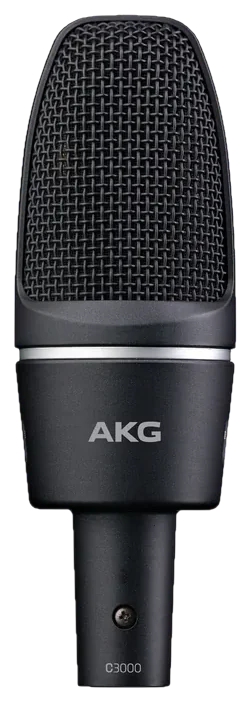
AKG
AKG C3000
Large-diaphragm (1-inch) condenser, cardioid, side-address studio and stage mic with 10 dB pad and bass cut (the redesigned C3000 of about 2012)
Approximate Some readings for this mic are uncertain; see the graphs.
Power Phantom 9 to 52 V (IEC 61938).
- Type
- Condenser
- Pattern
- Cardioid
- Sensitivity
- −34 dBV/Pa
- Among 204 condensers: more output than 69%
- Among 311 mics: more output than 79%
- Self-noise
- 14 dB(A)
- Among 258 condensers: quieter than 59%
- Among 272 mics: quieter than 60%
- Max SPL
- 140 dB SPL
- Among 277 condensers: takes louder sound than 62%
- Among 343 mics: takes louder sound than 56%
- Rated range
- 20 – 20k Hz
- Released
- 2012
vs 75 side-address condensers
More output than 62% of 75 side-address condensers.
Each stripe is one side-address condenser with a published sensitivity, and each bar counts them; further right means more output. This mic is in blue.
vs 99 side-address condensers
Quieter than 34% of 99 side-address condensers.
Each stripe is one side-address condenser with a published self-noise, and each bar counts them; further right means quieter. This mic is in blue.
vs 107 side-address condensers
Takes louder sound than 60% of 107 side-address condensers.
Each stripe is one side-address condenser with a published max SPL, and each bar counts them; further right means it takes louder sound. This mic is in blue.
Instruments sources recommend it for most
Proximity effect: the bass it gains up close
From the manual, p. 13.
"Frequency Response Curve"; relative dB, labelled +20 to -30. Distance, room and smoothing not stated. An unlabelled dashed line (about 10 to 25 dB lower) is also drawn and not stored.
Dashed: outside the rated range, or simulated (other angles and distances). Hover or tap the graphs for values.
Polar pattern
From the manual, p. 13. Approximate
"Polar Pattern": two half-plots, 0° at the bottom. Left: 125, 250 and 500 Hz drawn as one dashed line, 1000 Hz solid. Right: 2000 and 4000 Hz as one solid line, 8000 Hz dashed, 16000 Hz dotted. Rings labelled 0, -10 and -20 (5 dB per ring); centre circle -30 dB. Measuring conditions not stated.
Approximate: reading error up to about 1 dB.
In practice
All specs
| From the manual | ||
|---|---|---|
| Capsule | 1-inch diaphragm, gold-sputtered on one side onlyPage 10: "a diaphragm that is gold-sputtered on one side only to prevent local shorting to the back electrode". | p. 10 |
| Sensitivity | −34 dBV/Pa (20 mV/Pa)1 kHz. "20 mV/Pa (-32 dBV)"; 20 mV/Pa is -34.0 dBV, so the printed -32 dBV is taken as a misprint. | p. 13 |
| Self-noise | 14 dB(A)IEC 60268-4, A-weighted | |
| Max SPL | 140 dB SPL0.5% THD, pad off, 48 V phantom; also 150 dB SPL, 0.5% THD, -10 dB pad, 48 V phantom. "200 / 630 Pa = 140 / 150 dB SPL" (0/-10 dB); "Values for 48 V phantom power; reduce by 3 dB for 24 V and 6 dB for 12 V phantom power." | |
| Signal-to-noise ratio | 80 dBre 1 Pa, A-weighted, 48 V phantom. "80 dB*)"; the cut sheet says "> 80 dB-A". | |
| Dynamic range | 126 dBA-weighted, 48 V phantom. Page 10 says "a dynamic range of 136 dB (A-weighted)"; the specifications' 126 dB matches 140 dB SPL minus 14 dB(A). | |
| Output impedance | 200 ohmThe cut sheet: "<200 Ohms". | |
| Rated load impedance | 1000 ohmrecommended. The cut sheet: ">1000 Ohms". | |
| Rated frequency range | 20 Hz to 20 kHz"20 to 20,000 Hz (refer to frequency response curve)". | |
| Powering | phantom 9 to 52 V (IEC 61938) | |
| Current draw | 2 mA | |
| Low cut | off, on; 500 Hz; 6 dB/octave"Bass cut filter slope: 6 dB/octave below 500 Hz"; page 11: "The filter slope is more than 6 dB/octave at 500 Hz and below." The response graph marks the bass-cut curve "160Hz". | |
| Pad | −10 dB"-10 dB, switchable". | |
| Connector | XLR-3 male"3-pin male XLR to IEC standard". | |
| Weight | 320 gnet. "320 g (14.1 oz.)"; 320 g is 11.3 oz, as the 2012 cut sheet says. | |
| Dimensions | 53 × 162 mm"max. dia.: 53 mm (2.1 in.), length: 162 mm (6.4 in.)"; stored as diameter × length. | |
| Supplied accessories | H85 shock mountPage 10, packing list; the cut sheet: "H85 Universal Shock Mount". | p. 10 |
| Environment | -10 °C to +60 °C; relative humidity 90% (+20 °C), 85% (+60 °C) | p. 13 |
| Phantom voltage and headroom | Max SPL, S/N and dynamic range are for 48 V; reduce by 3 dB at 24 V and 6 dB at 12 V | |
| Controls | Pad selector on the left-hand side; bass cut selector | p. 11 |
| From the Recording Hacks page | ||
| Released | 2012 | |
| From the spec sheet | ||
| Housing | Heavy-duty die-cast metal | p. 1 |
Documents
- C3000 user manualDE, EN, FR, ES, IT, PT
- C3000 Professional Large-Diaphragm Condenser Microphone, cut sheet
- AKG Acoustics C3000 | RecordingHacks.com
Copies kept by Mic Archive (manufacturers move and drop their documents). Each is © AKG, unchanged, with its original address.
Recommended for
By recording guides, engineers and mic makers, for this mic or an earlier version of it.