Shure
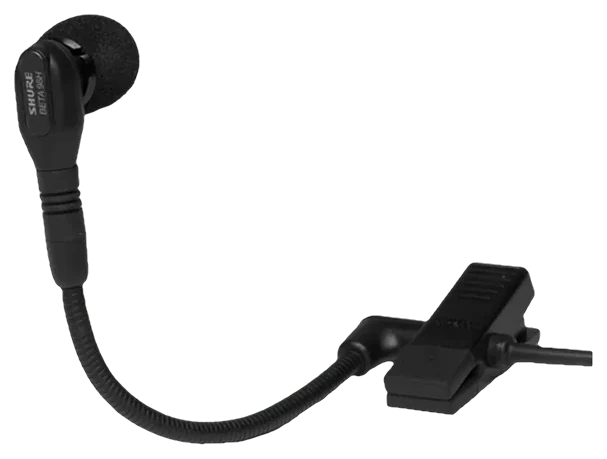
Shure Beta 98H/C
Miniature cardioid electret condenser instrument mic on a gooseneck with a clamp for horn bells and drum rims; RPM626 in-line preamp
Power Phantom 11-52 V DC (IEC-61938).
- Type
- Condenser (electret)
- Pattern
- Cardioid
- Sensitivity
- −56 dBV/Pa
- Among 204 condensers: more output than 2%
- Among 311 mics: more output than 10%
- Self-noise
- 31 dB(A)
- Among 258 condensers: quieter than 3%
- Among 272 mics: quieter than 3%
- Max SPL
- 155 dB SPL
- Among 277 condensers: takes louder sound than 97%
- Among 343 mics: takes louder sound than 95%
- Rated range
- 20 – 20k Hz
vs 16 clip-on condensers
More output than 13% of 16 clip-on condensers.
Each stripe is one clip-on condenser with a published sensitivity, and each bar counts them; further right means more output. This mic is in blue.
vs 14 clip-on condensers
Quieter than 23% of 14 clip-on condensers.
Each stripe is one clip-on condenser with a published self-noise, and each bar counts them; further right means quieter. This mic is in blue.
vs 16 clip-on condensers
Takes louder sound than 80% of 16 clip-on condensers.
Each stripe is one clip-on condenser with a published max SPL, and each bar counts them; further right means it takes louder sound. This mic is in blue.
Instruments sources recommend it for most
Proximity effect: the bass it gains up close
From the user guide, p. 3.
"Proximity Effect" graph (typical frequency response): solid line 61 cm (2 ft), dashed line 1 cm (0.4 in); relative dB. Room and smoothing not stated.
Dashed: outside the rated range, or simulated (other angles and distances). Hover or tap the graphs for values.
Polar pattern
From the user guide, p. 3.
Polar plots (no title) beside the response graph: two plots (125 to 500 Hz, 1 to 10 kHz), 0° at the bottom, 5 dB per ring.
In practice
All specs
| From the user guide | ||
|---|---|---|
| Capsule | interchangeable miniature cartridge: RPM108 cardioid (fitted), RPM110 supercardioid (optional)"Accessories and Parts". The 2005 guide lists both cartridges as replacement parts (page 9). | p. 3 |
| Sensitivity | −56 dBV/Pa (1.6 mV/Pa)1 kHz, open circuit. "−56 dBV/Pa (1.6 mV)". The 2005 guide gives -56.5 dB (1.5 mV) for the WB98H/C into its test circuit. | |
| Self-noise | 31 dB(A)equivalent output noise, A-weighted, typical | |
| Max SPL | 155 dB SPL1 kHz, 1% THD, 1 kohm load, typical; also 163 dB SPL, 2.5 kohm load (2005 guide); also 143.5 dB SPL, WB98H/C, standard test circuit (2005 guide). The 2005 guide, page 5: 163 dB into 2.5 kohm, 155 dB into 1 kohm; WB98H/C 143.5 dB. | |
| Signal-to-noise ratio | 63 dBref. 94 dB SPL at 1 kHz. "S/N ratio is difference between 94 dB SPL and equivalent SPL of self noise, A-weighted". | |
| Dynamic range | 124 dB1 kHz, 1 kohm load; also 132 dB, 2.5 kohm load. Printed as two lines, "124 dB" and "132 dB", with only the 1 kohm condition; the 2005 guide labels 132 dB "(2.5 k load)" (page 6). | |
| Output impedance | 150 ohmThe 2005 guide: "Rated at 150 ohm (actual)", recommended minimum load 1 kohm (page 5). | |
| Rated frequency range | 20 Hz to 20 kHz | |
| Connector | XLR-3 male on the RPM626 in-line preamplifierWiring diagram. The WB98H/C has a TA4F instead, for wireless bodypacks (2005 guide, page 3). | |
| Supplied accessories | 95A2398 zippered carrying bag; RPM626 in-line preamplifier"Furnished Accessories". | |
| Mount | Integrated gooseneck and ratcheting swivel joint, clamp for the bell of wind instruments or the rim of drums, isolation shock mount, gooseneck angle brace | p. 2 |
| Preamplifier output clipping level | 3 dBV (1.4 V), 1% THD | p. 3 |
| Optional accessories | RPM110 supercardioid cartridge; A412MWS metal locking windscreen | |
| Replacement parts | RK183WS snap-fit windscreens (4); RPM108 cardioid cartridge; RPM618 clamp assembly (A98D) | |
| PlacementShure | Reeds: a few inches from and aimed into the bell (bright). Brass: 30-90 cm on axis with the bell. Woodwinds: 2.5-15 cm on axis with the bell. Bell 90° off the mic axis for a softer, mellower sound | p. 2 |
| From the user guide (Recording Hacks copy) | ||
| Rated load impedance | 1000 ohmrecommended minimum; usable down to 150 ohm with reduced clipping level | p. 5 |
| Weight | 156 gmic with cable and preamplifier. WB98H/C with cable and TA4F: 65 g. | p. 6 |
| Electronics | Transformerless preamplifier | p. 2 |
| Operating conditions | –7 to 49 °C operating, –29 to 74 °C storage, 0 to 95% relative humidity | p. 6 |
| WB98H/C supply | 5 V recommended operating voltage (pin 2 to pins 3 and 4) | |
| From the spec sheet | ||
| Powering | phantom 11-52 V DC (IEC-61938)"11–52 VDC phantom power (IEC-61938), 1.2 mA". The guide: "performs best with a 48 Vdc supply" (page 2). | p. 1 |
| Current draw | 1.2 mA | |
| Models | Beta 98H/C: with RPM626 in-line XLR preamplifier; WB98H/C: 1.6 m (5.3 ft) cable with TA4F for Shure wireless bodypacks | |
Documents
- BETA 98H/C Cardioid Condenser Microphone, user guide27A14090 Rev. 2
- Beta 98H/C Miniature Cardioid Condenser Horn Microphone, Product Specifications
- Condenser Instrument Microphone Models Beta 98H/C and WB98H/C User Guide27E3102 Rev. 5
Copies kept by Mic Archive (manufacturers move and drop their documents), unchanged, with their original addresses. Each is © its publisher.
Recommended for
By recording guides, engineers and mic makers, for this mic or an earlier version of it.